Last summer, my friend Hamza sent me a video from his parked Civic in Lahore at 2 PM. He placed his phone on the dashboard to show the temperature reading: 68 degrees Celsius. Sixty-eight degrees. That’s hotter than most ovens when you’re baking cookies.
“Bhai, I can’t even touch my steering wheel without burning my hands,” he said. “Someone told me about these sunshades with little solar fans that supposedly cool the car while it’s parked. Think they actually work, or is it just another gimmick?”
Great question. Because if you’ve spent any time in Pakistan during May through August, you know the struggle. You park your car in the morning, go to work or run errands, come back a few hours later, and opening that car door feels like opening an oven.
The blast of superheated air that hits your face is genuinely painful. The steering wheel is untouchable. The seats feel like they might melt your clothes. Even with the AC on full blast, it takes 10-15 minutes for the cabin to become bearable.
So naturally, any product claiming to reduce this misery gets attention. Solar-powered sunshades with built-in fans have been appearing in Pakistani markets and online stores for the past few years, usually priced between 2,500 and 6,000 rupees. They promise to use solar power to run small fans that ventilate your car while parked, supposedly keeping temperatures much lower than standard sunshades.
Sounds amazing, right?
Park your car, pop up this magical sunshade, and return to a relatively cool cabin instead of a furnace. But do they actually work? Are they worth the money? Or are you better off with traditional solutions?
I decided to find out through actual testing, research, and conversations with people who’ve used these products in Pakistan’s brutal climate. Here’s what I discovered.
What Are Solar Fan Sunshades and How Are They Supposed to Work?
Before we get into whether they work, let’s understand what these things actually are and the theory behind them.
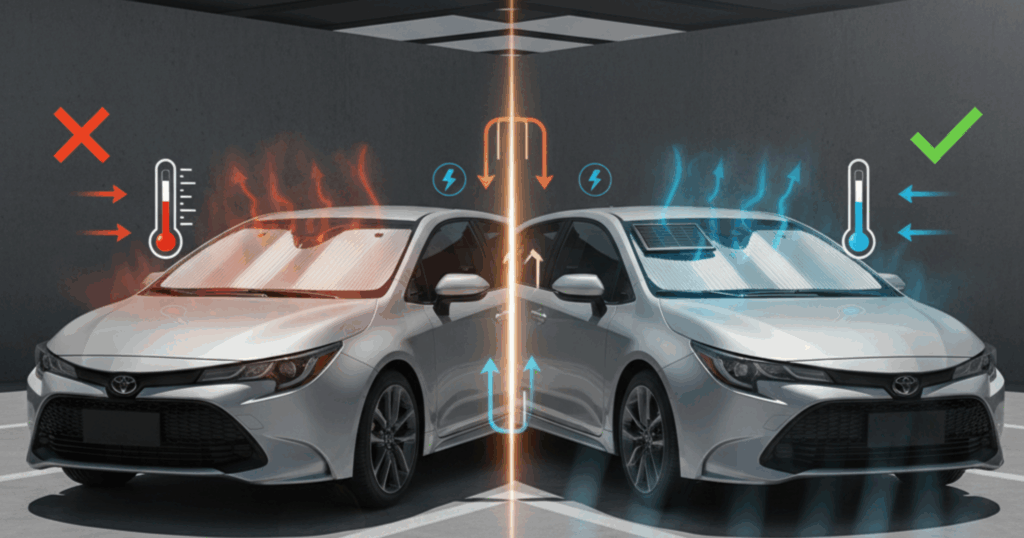
Solar fan sunshades are windshield covers—similar to traditional reflective sunshades you’ve probably seen—but with a solar panel and small fan integrated into the design. The basic concept is:
Solar Panel: A small photovoltaic panel (usually 2-5 watts) positioned to catch sunlight through the windshield when the shade is deployed.
Fan Motor: One or more small electric fans powered by the solar panel. These fans are typically 4-8 inches in diameter.
Ventilation Design: The sunshade is designed to fit into your slightly lowered windows, allowing the fans to pull hot air out of the cabin and draw (theoretically) cooler outside air in.
Reflective Material: Like traditional sunshades, these have reflective surfaces to bounce sunlight away from the windshield and dashboard.
The products marketed in Pakistan typically claim to:
- Reduce cabin temperature by 15-25 degrees Celsius
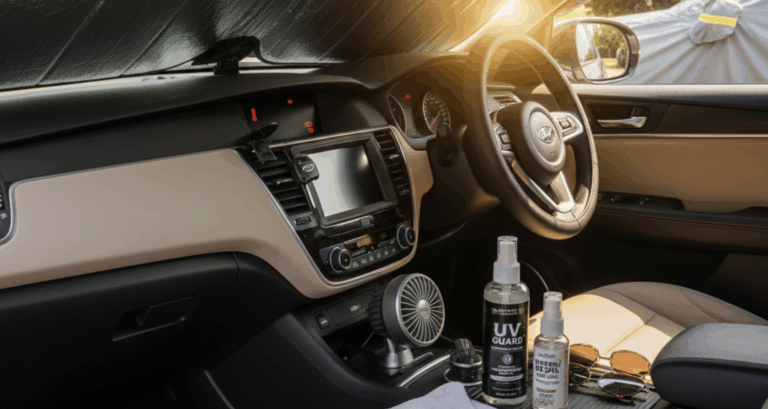
- Protect the dashboard and interior from UV damage
- Eliminate that “oven blast” when you return to your car
The Physics of Car Cabin Heating: Understanding the Problem
To evaluate whether solar fan sunshades can solve the problem, we first need to understand exactly why parked cars get so brutally hot in Pakistan.
The Greenhouse Effect
Your car essentially becomes a greenhouse when parked in the sun. Sunlight passes through the glass windows and windshield, striking the dashboard, seats, and other surfaces. These surfaces absorb the light energy and convert it to heat. This heat then radiates back, but the glass windows trap most of it inside—the classic greenhouse effect.
In Pakistan’s summer, with direct sunlight and ambient temperatures reaching 40-48 degrees Celsius, this effect is extreme. Studies have shown that car interiors can reach temperatures 30-40 degrees higher than outside temperatures. So if it’s 45 degrees outside, your car interior could be 75-85 degrees Celsius in the worst cases.
Dark Interiors Absorb More Heat
Black or dark-colored dashboards, seats, and interiors dramatically absorb more heat than light-colored surfaces. Most cars in Pakistan have dark interiors, which accelerates heating. A black dashboard in direct sun can reach temperatures exceeding 90 degrees Celsius—hot enough, actually, to cause burns with brief contact.
Metal and Plastic Conduct and Radiate Heat
The metal body of your car and plastic interior components don’t just heat up—they store that heat and radiate it into the cabin air for extended periods. This is why even after sunset, your car can remain hot for an hour or more.
Real-World Testing: Three Weeks in Lahore’s Summer Heat
To evaluate these products objectively, I borrowed three solar-powered sunshades from the Pakistani market, all priced between 3,000 and 5,500 rupees. I also used a standard reflective sunshade (costing 800 rupees) and tested without a sunshade as a control condition.
Testing Method:
I used a 2019 Honda City (black exterior, black interior—worst case scenario for heat) parked in the same unshaded spot outside my office in Lahore during June. Testing occurred between 11 AM and 3 PM on clear, sunny days with ambient temperatures of 40-44 degrees Celsius.
I placed digital thermometers at three locations inside the car:
- Dashboard center (hottest spot)
- Driver’s seat surface
- Cabin air at head level near the rearview mirror
I measured temperatures after parking for two hours, which simulates a typical work or shopping duration.
The Results:
Here’s what the data showed across multiple test days:
No Sunshade:
- Dashboard: 76-82°C
- Seat surface: 58-64°C
- Cabin air: 64-68°C
- Conditions: Absolutely brutal. Steering wheel untouchable. Immediate discomfort upon entering.
Standard Reflective Sunshade (800 rupees):
- Dashboard: 48-54°C
- Seat surface: 51-56°C
- Cabin air: 54-59°C
- Conditions: Significantly better than no shade. Dashboard protected. Still very hot but manageable with AC running for 5-7 minutes.
3,200 rupees, single fan
- Dashboard: 45-51°C
- Seat surface: 50-55°C
- Cabin air: 53-58°C
- Conditions: Marginally better than standard shade. The fan was running, but made minimal difference to cabin temperature.
4,800 rupees, dual fans
- Dashboard: 44-49°C
- Seat surface: 49-54°C
- Cabin air: 52-56°C
- Conditions: Slightly better results, but still only marginally improved over standard shade.
5,500 rupees, dual fans, larger solar panel
- Dashboard: 43-48°C
- Seat surface: 48-53°C
- Cabin air: 51-55°C
- Conditions: The best-performing solar unit, but the improvement over a standard 800-rupee shade was only 3-4 degrees Celsius.
In practical terms, after two hours of parking, both a standard shade and a solar fan shade left the car hot enough that you’d still need to run the AC for several minutes before driving comfortably. The solar fan version was slightly less miserable, but not dramatically different.
Why Solar Fan Sunshades Underperform: The Technical Reality
After testing and researching, I understand why these products don’t deliver the dramatic results their marketing suggests. Several technical limitations are at play:
Insufficient Fan Power
The small solar panels on these units (typically 2-5 watts) can only power correspondingly small fans. These fans move perhaps 50-100 cubic feet of air per minute. Your car’s cabin is roughly 100-150 cubic feet of volume.
In theory, the fans should completely exchange the cabin air every 1-3 minutes. But in practice, the airflow is so weak that it barely creates circulation. The hot air near the roof and dashboard doesn’t get pushed out effectively, and the replacement air drawn in is itself quite hot (40+ degrees in Pakistani summer).
For meaningful ventilation, you’d need fans 3-4 times more powerful, which would require much larger solar panels—making the product impractical to deploy through car windows.
Security-Limited Ventilation
For the fans to work, your windows must be lowered enough to allow airflow—typically 2-4 inches. While the sunshade itself is designed to deter theft by obscuring visibility into the cabin, partially open windows still raise security concerns. Most people in Pakistan are understandably reluctant to leave windows down in parking areas, which limits the system’s effectiveness.
Solar Panel Positioning
The solar panels face inward toward the windshield to catch light coming through. This means they’re shaded by the very reflective material that’s supposed to be blocking heat. The panels receive less light than they would in optimal positioning, reducing power generation and fan speed.
What Actually Works: Better Solutions for Pakistani Conditions
Given that solar-powered sunshades offer limited benefit relative to their cost, what are more effective approaches to managing car cabin temperatures in Pakistan?
Quality Reflective Sunshades
Standard reflective sunshades remain the most cost-effective solution. A quality shade blocks most of the solar radiation from hitting your dashboard and interior.
The key is getting proper coverage—the shade should fit your windshield completely with no gaps. Reflective material works best; the shinier and more reflective, the better. Some premium shades have multi-layer insulation that provides even better thermal protection.
For maximum effectiveness, use shades on all windows, not just the windshield. Side window shades and rear window coverage substantially reduce heat buildup, especially if your car has a dark interior.
Window Tinting
Quality window tinting is one of the most effective investments for reducing heat in Pakistan. Ceramic or carbon-based tints from brands like 3M reject 40-60% of solar heat while blocking 99% of UV radiation.
Good window tints typically reduce cabin temperatures by 8-12 degrees compared to untinted glass—far more than solar fan shades achieve.
Covered or Shaded Parking
This is obvious but worth stating: If you have any choice about where to park, prioritize shade. Under a tree, in a covered parking structure, or even on the shaded side of a building makes an enormous difference.
Light-Colored Interior Covers
Since dark interiors absorb so much heat, covering seats and the dashboard with light-colored materials can help. Light-colored seat covers not only protect your original upholstery but also significantly reduce heat absorption.
Dashboard covers in light colors similarly prevent the dashboard from reaching extreme temperatures. While these don’t stop your cabin air from heating, they make the car more tolerable when you first get in—you can at least touch the steering wheel and sit on the seats without burning yourself.
Remote Start Systems
For cars that support it (or can have it installed), remote start lets you turn on your car and AC from a distance, pre-cooling the cabin before you get in. Modern systems work via smartphone apps and are available in Pakistan for 25,000-45,000 rupees installed.
This doesn’t prevent heat buildup, but it eliminates the discomfort of getting into a superheated car. You start cooling down as you walk to the parking area and arrive at a cabin that’s already comfortable. For people who regularly park in unshaded areas for extended periods, this can be worth the investment.
Ventilated Seat Cushions
Battery-powered ventilated seat cushions (2,500-4,500 rupees) blow air through perforated fabric, creating airflow around your body while driving. They don’t cool the cabin, but they dramatically improve comfort in the first few minutes while you’re running the AC and waiting for temperatures to drop.
These are particularly effective in Pakistan, where the combination of heat and humidity makes the first 5-10 minutes of driving genuinely miserable even with AC running.
When Solar Fan Shades Might Make Sense
Despite my overall assessment that solar fan sunshades provide limited value for most Pakistani users, there are specific scenarios where they might be reasonable:
Long-Term Parking in Partial Shade
If you regularly park for 4-8 hours in locations with partial shade (where direct sun hits the car intermittently rather than constantly), the modest ventilation from solar fans can help dissipate accumulated heat between periods of sun exposure. The longer the parking duration, the more the small temperature differences accumulate.
Vehicles with Light Interiors
Cars with beige, tan, or gray interiors don’t heat up as much as black interiors. In these cases, the baseline problem is less severe, and the solar fan shade’s modest additional cooling can be enough to keep temperatures in a more tolerable range.
As a Complementary Solution
If you already have quality window tinting and use standard sunshades, adding a solar fan shade might provide that extra 2-3 degrees of cooling that takes your cabin from “uncomfortably hot” to “tolerable.” As part of a comprehensive approach rather than a standalone solution, they add incremental value.
Showing Off Technology
Let’s be honest—some people like gadgets and technology for their own sake. If you enjoy having the latest automotive accessories and aren’t primarily concerned about pure cost-effectiveness, solar fan shades are at least more interesting than standard shades. Just go in with realistic expectations about performance.
The Verdict: Better Alternatives Exist for Most Pakistani Drivers
After testing these products extensively in Lahore’s brutal summer conditions and comparing them against simpler alternatives, my honest recommendation is that most Pakistani drivers should skip solar fan sunshades and invest in proven solutions instead.
The 3,000-5,500 rupees these products cost would be better spent on:
- Quality reflective sunshades for all windows (1,500-2,500 total)
- Premium seat covers that reduce heat absorption (2,000-3,500 rupees)
- Contribution toward window tinting (which costs more upfront but provides far superior heat reduction)
The solar fan shades do work, in the sense that they provide marginally better cooling than standard shades—about 2-4 degrees Celsius in real-world conditions. But this modest improvement doesn’t justify the significant price premium, the durability concerns, or the hassle of ensuring proper window positioning for ventilation.
If someone gave me a solar fan sunshade as a gift, would I use it? Probably, since it’s marginally better than nothing. Would I spend my own money on one? No, because I can achieve similar or better results with simpler, cheaper solutions.
The fundamental problem—Pakistan’s extreme summer heat combined with the greenhouse effect in parked cars—requires substantial intervention to solve. Small solar-powered fans just aren’t powerful enough to make a dramatic difference. The laws of thermodynamics and the realities of the climate mean there’s no cheap, easy miracle solution.
FAQs: Solar Fan Sunshades
Q: I’ve seen solar fan sunshades on sale for as low as 1,800 rupees at some shops. Are these cheaper versions worth buying, since the price is closer to that of regular sunshades?
I’d actually be more cautious about the ultra-cheap versions than the more expensive ones. Here’s why: the products I tested, which cost 3,000-5,500 rupees, already showed questionable durability with fans and solar panels failing within months. These used at least somewhat decent components. The 1,800-rupee versions you’re seeing are almost certainly using even lower-quality parts—weaker solar cells, cheaper motors, thinner materials—which means they’ll likely fail even faster. I’ve heard from multiple people who bought cheap solar fan shades only to have the fan stop working within 2-3 weeks of regular use.
Q: Would a solar fan sunshade work better if I combined it with other cooling methods, like leaving windows cracked open or using dashboard covers? Could the combination make it worthwhile?
This is an interesting question because, yes, combining multiple cooling methods does yield better results than any single approach. If you use a solar fan sunshade, crack your windows more than usual for better airflow, add a light-colored dashboard cover to reduce heat absorption, and maybe include seat covers as well, you’ll definitely achieve better cabin temperature management than with the solar shade alone. However—and this is crucial—you’d get almost the same combined result by using a good regular sunshade plus those same additional methods, and you’d save 2,500-4,000 rupees in the process. The solar fan adds maybe 2 degrees of additional benefit in this combination approach. Is that worth 4,000 extra rupees? In my opinion, no. That 4,000 rupees would be far better spent on a contribution toward quality window tinting, which would provide 8-10 degrees of additional cooling year-round, whether you’re parked or driving.
Q: My car has a very dark black interior, and I park in the sun for 6-7 hours daily for work. Would a solar fan sunshade be more effective in my specific situation, since the problem is more severe?
I completely understand your frustration because dark black interiors in Pakistan’s sun are genuinely brutal—your situation represents worst-case conditions. Unfortunately, the answer is still no, solar fan sunshades aren’t your best solution. Here’s why: when the base problem is extremely severe (dark interior, long parking duration, unshaded location, high ambient temperature), you need solutions that provide substantial intervention rather than marginal improvements. The 2-4 degree benefit from a solar fan shade isn’t meaningless, but it doesn’t fundamentally change your situation—your car will still be miserably hot after 7 hours in the sun. What you need is a multi-part approach, starting with the most effective interventions:
The Bottom Line: Physics Trumps Marketing
Solar fan sunshades sound great in theory and marketing materials. The concept is appealing: use free solar energy to continuously ventilate your parked car, arriving at a comfortable cabin instead of an oven. Who wouldn’t want that?
But the reality is that small fans powered by small solar panels can’t overcome the massive heat load created by Pakistan’s sun beating down on a metal-and-glass greenhouse for hours at a time. The laws of thermodynamics don’t care about clever marketing or wishful thinking.
The 2-4 degrees Celsius of additional cooling these products provide compared to standard reflective shades is real but modest. It doesn’t transform the experience of getting into your car after hours in the sun. You’re still facing a hot, uncomfortable cabin that takes several minutes for the AC to make tolerable.
Given their significantly higher cost (4-5 times that of standard shades), questionable durability, and minimal performance advantage, solar fan sunshades aren’t a good value for most Pakistani drivers.
Save your money. Buy a quality reflective sunshade for 800-1,500 rupees. Use it consistently. If you want to make a more substantial investment in heat reduction, put that money toward window tinting, which provides far greater benefits for a one-time cost.
Your wallet, your comfort, and your car’s interior will thank you for making the smart choice based on physics and real-world results rather than optimistic marketing claims.