
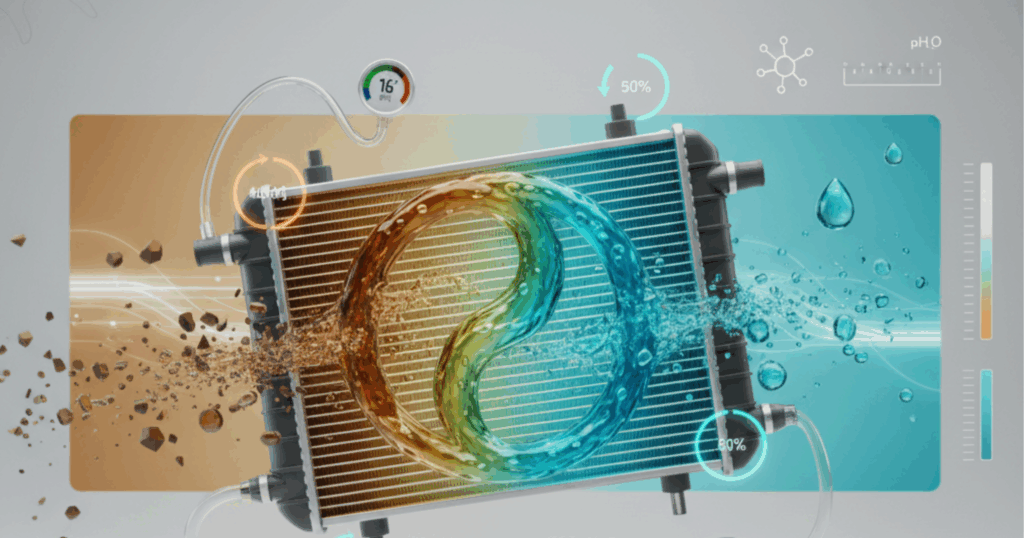
Did you know there are three common mistakes thousands of Pakistani car owners make every year when attempting radiator flushes? They include using tap water instead of distilled water, running the engine for too long during the flush, and forgetting to burp the cooling system afterward, which can cause an airlock that leads to overheating and ultimately cracking the radiator core. I’m writing this guide to help you prolong your car’s radiator life.
Flushing your radiator is actually one of the most important maintenance tasks you can do for your car, especially in Pakistan’s brutal heat. But do it wrong, and you’ll cause more problems than you solve.
Why Radiator Flushing Matters More in Pakistan Than Anywhere Else
Before we get into the how-to, let’s talk about why this matters so much for Pakistani car owners specifically.
Pakistan’s climate is absolutely brutal on cooling systems. We’re talking 45-48 degree summers in places like Jacobabad, Multan, and interior Sindh. Even in “cooler” cities like Lahore and Islamabad, summer temperatures regularly hit 40+ degrees. Your car’s cooling system is working overtime to keep your engine from turning into a molten brick.
Add to that our traffic conditions. Stop-and-go traffic on M.M. Alam Road, bumper-to-bumper jams on Shahrah-e-Faisal, hour-long crawls on GT Road—your engine is running hot with minimal airflow through the radiator. This puts enormous stress on the cooling system.
Then there’s our fuel quality and the general condition of our roads. Dust, pollution, and contaminants make their way into cooling systems. The coolant breaks down faster here than it would in cooler, cleaner environments.
All of this means your radiator and cooling system need more frequent maintenance than those in other countries. While manufacturers might recommend coolant changes every 60,000 km or 2 years in moderate climates, in Pakistan, you should think about it every 40,000 km or annually, whichever comes first.
What Actually Happens During a Proper Radiator Flush
A radiator flush isn’t just draining old coolant and pouring in new stuff. That’s a coolant change, and it’s different.
A proper flush involves removing old coolant, running a cleaning solution through the entire cooling system to break down scale and deposits, thoroughly rinsing everything out, and then filling with fresh coolant mixed to the proper ratio.
Over time, coolant breaks down and becomes acidic. This acid eats away at metal components, creates rust and scale deposits, and forms sludge that can block narrow passages in your radiator core. These deposits reduce cooling efficiency, cause hot spots, and eventually lead to leaks or catastrophic failures.
A proper flush removes this buildup and gives your cooling system a fresh start. But—and this is critical—the process itself can cause problems if done incorrectly. Those deposits might be partially blocking a weak spot that would leak if the deposits were removed. The cleaning chemicals can damage rubber hoses if left in too long. High-pressure flushing can crack an already-weakened radiator core.
This is why technique matters so much.
The Tools and Materials You Actually Need
Let me give you the complete list of what you need for a proper radiator flush in Pakistan. Don’t skip items to save money—each one serves a purpose.
Essential Tools:
- Large drain pan (at least 10-liter capacity)
- Socket set and wrenches (sizes vary by car)
- Funnel (a long-neck funnel makes this much easier)
- Garden hose with adjustable nozzle
- Rubber gloves
- Safety glasses
- Old towels or rags
- Large bucket for mixing coolant
Materials You’ll Need:
- Radiator flush cleaning solution (I recommend brands like Liqui Moly or K2 available at Autostore.pk)
- Distilled water (NOT tap water—I’ll explain why shortly)
- Fresh coolant appropriate for your car (usually 4-6 liters, depending on your vehicle)
- New radiator cap (if yours is old or shows wear)
- Zip ties or hose clamps (in case you need to secure loose hoses)
The Critical Difference Between Tap Water and Distilled Water
This deserves its own section because it’s the single most common mistake Pakistani DIYers make.
Tap water in Pakistan—whether you’re in Karachi, Lahore, Faisalabad, or anywhere else—contains minerals. Lots of them. Calcium, magnesium, iron, and various other dissolved solids. These minerals form scale deposits when heated, exactly like the white buildup you see in your electric kettle.
Inside your engine’s cooling system, these scale deposits are catastrophic. They coat the inside of passages, reducing heat transfer. They clog narrow channels in your radiator core. They create rough surfaces where corrosion can start. Over time, they can completely block cooling passages, leading to localized overheating and engine damage.
Distilled water has had all minerals removed. It won’t form scale deposits. It’s what you absolutely must use for flushing and for mixing with coolant.
“But bhai,” I hear you saying, “my mechanic always uses tap water, and his cars run fine.”
Maybe they do, for now. But you’re creating problems that will surface in 2-3 years. I’ve seen radiators completely clogged with scale, even though they had been serviced regularly with tap water. The mechanic who did the work is long gone, but the car owner is stuck with the repair bill.
Distilled water costs 80-120 rupees per liter at most medical stores or larger supermarkets. For a radiator flush, you’ll need about 10-15 liters total. That’s 1,000-1,500 rupees—absolutely worth it to protect a cooling system that costs tens of thousands to repair.
If you absolutely cannot find distilled water (though it’s widely available in cities), boiled and cooled water is a marginal compromise. Boiling removes some minerals and kills bacteria, but it’s not as good as distilled water. Never, ever use straight tap water.
Step-by-Step: The Safe Way to Flush Your Radiator
Right, let’s get into the actual procedure. I’m writing this assuming you’re working on a typical Pakistani car—Toyota Corolla, Honda Civic, Suzuki Alto, City, something in that range. The principles apply to any car, though specific details might vary.
Step 1: Choose Your Location and Timing
Do this in a shaded area if possible, ideally in the morning before the day gets hot. You need the engine completely cold—at least 3-4 hours since it was last run, preferably overnight. Never, ever attempt to flush a hot engine. The coolant is under pressure and can spray out, causing serious burns.
Make sure you’re working on a level surface. You’ll be draining and filling fluids, and you want accurate levels. Set up your drain pan and have your materials organized within reach.
Step 2: Locate Your Drain Points
Open your bonnet and locate your radiator. On most cars, the radiator is at the front of the engine bay, directly behind the front grille. You’ll see two hoses connected to it—one at the top, one at the bottom.
The radiator drain plug is usually at the bottom corner of the radiator, sometimes on the driver’s side, sometimes on the passenger side. It might be a plastic wing nut you can turn by hand, or it might require a wrench. On some cars, there isn’t a drain plug, and you’ll need to remove the lower radiator hose instead.
You also need to locate the engine block drain plug if your car has one (not all do). This is usually on the side of the engine block, low down. Check your owner’s manual or ask at an Autostore.pk location—they can tell you specifically for your model.
Step 3: Remove the Radiator Cap
With the engine cold, carefully remove the radiator cap by pressing down and turning counterclockwise. Some cars have a pressurized reservoir instead of a traditional radiator cap—if so, you’ll open that instead.
Set the cap aside somewhere clean. Inspect it for cracks or worn rubber seals. If it looks dodgy, replace it. A new cap costs 500-1,500 rupees, depending on your car model, and it’s cheap insurance against cooling system problems.
Step 4: Drain the Old Coolant
Position your drain pan under the radiator drain plug. Open the plug slowly—coolant will start flowing out. On cars without a drain plug, you’ll need to remove the lower radiator hose. Loosen the hose clamp, have your drain pan ready, and pull the hose off. Coolant will pour out quickly, so be prepared.
Let everything drain completely. This takes 10-15 minutes. While it’s draining, inspect the coolant. What color is it? Fresh coolant is usually bright green, pink, orange, or blue, depending on type. Old coolant turns brown or rust-colored. If yours looks like dirty tea, you’ve definitely waited too long.
Does it smell burnt? That’s bad—indicates overheating. Any oil floating in it? That’s even worse—suggests a head gasket leak. Chunky bits? That’s rust and scale, which is exactly why you’re doing this flush.
Step 5: Drain the Engine Block
If your car has an engine block drain plug, open it now and drain that coolant as well. This removes coolant from the engine that wouldn’t otherwise drain out of the radiator.
Not all cars have this feature. If yours doesn’t, don’t worry—the flushing process will still work, it’ll just take a bit more flushing solution to clean everything thoroughly.
Step 6: Close Drains and Add Flush Solution
Once everything has drained, close your drain plug (or reconnect your lower hose) securely. Make sure it’s tight—you don’t want leaks when you start the engine.
Now pour in your radiator flush cleaning solution. Follow the instructions on the bottle—usually you’ll add the entire bottle of flush solution, then fill the rest of the system with distilled water.
Fill slowly through the radiator opening (or reservoir, depending on your car’s setup). The cooling system holds more than you might think—typically 6-8 liters on most sedans, more on larger vehicles.
Step 7: Run the Engine with Flush Solution
Replace the radiator cap (but don’t tighten it fully—keep it loose to prevent pressure buildup). Start the engine and let it run until it reaches normal operating temperature. You can tell it’s reached temperature when the cooling fan kicks on—this usually takes 10-15 minutes.
While the engine runs, watch the temperature gauge carefully. If it starts climbing toward the hot zone, shut off immediately—you might have an airlock or other issue.
With the engine running, turn your heater to maximum hot and maximum fan speed. This opens the heater core valve, allowing the flush solution to circulate through your heater core and clean it.
Step 8: Drain the Flush Solution
After the recommended time has passed, turn off the engine and let it cool for at least 30 minutes. Never open a hot cooling system.
Once cool, open your drain plug again and drain out all the flush solution and dirty water. This will come out looking pretty nasty—that’s all the crud that was building up in your cooling system.
Step 9: Rinse Thoroughly
This is the step most people skip, and it’s crucial. Close your drain plug, then fill the system with distilled water. Yes, using all this distilled water is wasteful, but trust me.
Start the engine again, run it for 5-10 minutes to circulate the water through the entire system, then turn it off and let it cool. Drain this rinse water completely.
Repeat this rinse process at least twice, preferably three times. You’re making sure all traces of the cleaning chemicals are gone. Any residual flush solution will contaminate your fresh coolant and can damage your system.
The rinse water should come out progressively cleaner each time. On your final rinse, it should be coming out nearly clear. If it’s still dirty after three rinses, your system was really crudded up, and you should do another rinse.
Step 10: Fill with Fresh Coolant
Now for the moment of truth. You’re going to fill your system with fresh coolant mixed at the proper ratio.
Most coolants in Pakistan are sold as concentrated formulas that need to be mixed 50/50 with distilled water. This means 1 liter of coolant concentrate mixed with 1 liter of distilled water. Some newer coolants are pre-mixed—read your label carefully.
Why 50/50? Pure coolant actually freezes at a higher temperature and boils at a lower temperature than a 50/50 mix. The mixture provides the best protection against both freezing and boiling. Yes, we don’t typically worry about freezing in most of Pakistan, but the boiling-point protection is critical, and the corrosion inhibitors work best at a 50/50 ratio.
Mix your coolant and distilled water in a clean bucket before pouring it in. This ensures a consistent mixture throughout the system. Pour slowly through the radiator opening, pausing occasionally to let air bubbles rise and escape.
Fill until coolant reaches the proper level—there’s usually a mark inside the radiator neck, or if you’re filling through a reservoir, fill to the “cold full” line.
Step 11: Burp the System
Air pockets in the cooling system create hot spots that can cause localized overheating and damage. You need to “burp” the system to remove these air pockets.
With the radiator cap (or reservoir cap) still off, start the engine. Keep it at a fast idle (about 1,500-2,000 RPM). Watch the coolant—you’ll see it start to circulate and drop as air bubbles escape and the coolant expands as it heats up.
Keep adding coolant as the level drops. Squeeze the upper radiator hose a few times—this helps dislodge stubborn air pockets. Turn your heater to max hot again to ensure the heater core is bled of air.
Once the cooling fan has cycled on and off at least once, and you’re not seeing any more air bubbles coming up, the system should be properly bled. Top off the coolant one final time, then install the radiator cap securely.
Step 12: Final Checks
Top off your overflow reservoir to the proper level. Start the engine and let it run while you carefully inspect for leaks. Check around the radiator drain plug, all hose connections, and anywhere you worked.
Take the car for a short drive around your neighborhood, watching the temperature gauge carefully. It should stay in the normal range. When you get back, let the car cool completely, then check the coolant level again and top off if needed.
The Types of Coolant and Which One Your Car Actually Needs
Walk into any auto parts shop in Pakistan, and you’ll see coolant in at least four different colors—green, pink, orange, and blue. They’re not just different colors of the same thing. These are different formulations with different additives, and using the wrong one can cause problems.
Green Coolant (IAT – Inorganic Additive Technology): This is the old-school stuff that’s been around since the 1960s. It uses silicate and phosphate corrosion inhibitors. It’s the cheapest option and works fine for older cars (pre-2000s generally). Needs changing every 2 years or 40,000 km. Most Pakistani mechanics default to this because it’s what they’ve always used.
Orange/Red Coolant (OAT – Organic Acid Technology): This is the modern stuff used in most newer cars. Uses organic acids for corrosion protection and lasts much longer—typically 5 years or 150,000 km. More expensive but better protection. Most Japanese cars from 2005 onwards use this type.
Pink Coolant (HOAT – Hybrid Organic Acid Technology): A hybrid combining IAT and OAT technologies. Used by many European manufacturers and some Japanese cars. Typically good for 3-5 years.
Blue Coolant: Usually indicates a Honda-specific formulation. If you drive a Honda, use their specific coolant—mixing other types can cause problems.
So which one should you use? Check your owner’s manual first. If that’s not available, check what’s already in your car. If you’re switching types, you must flush thoroughly to remove all traces of the old coolant—mixing types creates sludge.
For most Pakistani cars (Corollas, Civics, Altos, Cities), a high-quality OAT coolant will serve you well. Yes, it costs more upfront—maybe 1,200-1,800 rupees per liter versus 600-800 rupees per liter for green coolant—but the longer service life makes it worthwhile.
The Pakistani Climate Factor: Why We Need Different Maintenance Schedules
Everything I’ve written so far applies anywhere, but let’s talk specifically about operating cars in Pakistan’s conditions and how that should inform your cooling system maintenance.
Pakistani summers are brutal. We regularly exceed temperatures considered extreme heat waves in other countries.
Our traffic conditions mean extended idling and low-speed operation—worst case for cooling because there’s minimal airflow through the radiator. Your electric cooling fan is doing all the work, and if it’s weak or your coolant is degraded, you’re in trouble.
Dust and pollution are everywhere. Even if you’re religious about air filter changes, some contamination gets into the cooling system over time. This accelerates coolant degradation.
Fuel quality varies. Lower-quality fuel burns hotter and less efficiently, making your engine run hotter overall. This stresses the cooling system.
All of this means Pakistani cars need more frequent cooling system maintenance than the manufacturer’s recommended schedule, which is usually based on ideal conditions.
My recommendation based on Pakistani conditions:
- City driving (Lahore, Karachi, Islamabad traffic): Inspect coolant every 6 months, full flush every 12 months or 30,000 km
- Highway driving: Inspect coolant every 6 months, full flush every 18 months or 40,000 km
- Mixed driving: Inspect every 6 months, full flush every 15 months or 35,000 km
The Life After Flush: Maintaining Your Cooling System Long-Term
Getting a proper flush done is great, but maintaining your cooling system between flushes is what really protects your engine. Here’s what you should be doing:
Monthly quick checks: Once a month, when the engine is cold, check your coolant level. It should be between the min and max marks on your overflow reservoir. If it’s dropping, you have a leak that needs to be found.
Watch your temperature gauge: Know where your gauge normally sits. If it starts running hotter than usual, investigate immediately. Catching overheating early prevents serious damage.
Listen for odd sounds: If your water pump is failing, you might hear squealing or grinding from the front of the engine. If your cooling fan isn’t working properly, you might notice excessive noise or no noise at all when it should be running.
Check for leaks after parking: Look under your car. Spots of coolant (usually bright-colored) mean you’re leaking. Find it early.
Proper car care routine: Regular washing removes corrosive salt and chemicals from your radiator’s exterior fins. A clogged radiator can’t cool properly, even if the coolant is perfect.
FAQs: Car Radiator
Q: My mechanic says I should flush my radiator every 20,000 km, but the manual says 60,000 km. Who’s right for Pakistan?
Both are partially right for different reasons, but for Pakistan specifically, I’d split the difference and recommend every 30,000-40,000 km, depending on your driving conditions. Here’s why: car manufacturers base their maintenance schedules on ideal conditions—moderate climate, good fuel quality, well-maintained roads, and regular highway driving. These conditions don’t exist in most of Pakistan. We have extreme heat, variable fuel quality, dusty conditions, and heavy traffic, all of which keep your cooling system under constant stress. Your coolant degrades faster here than it would in Germany or Japan, where these schedules were developed.
Q: I did a radiator flush following these steps, but now my temperature gauge sits slightly higher than before. Did I damage something, or is this normal?
First, don’t panic—this is actually quite common and usually fixable. The most likely cause is air still trapped in your cooling system, creating airlocks that prevent proper coolant circulation. Even with proper burping procedures, stubborn air pockets can remain, especially in cars with complex cooling systems or heater core circuits. Here’s what you should do: with the car on level ground and engine completely cold, remove the radiator cap or reservoir cap. Start the engine and let it idle while watching the coolant level. As the engine warms up, you should see circulation begin and possibly more air bubbles emerging. Top off the coolant as needed. Run the engine until the cooling fan cycles on at least once. Turn your heater to maximum hot and maximum fan speed—this helps purge air from the heater core.
Q: I have a relatively new car (2023 model) that came with long-life coolant. Do I still need to flush it, or can I keep topping it off until the manufacturer’s recommended interval?
This is a great question because newer cars do come with extended-life coolant (usually OAT or HOAT formulations) that are genuinely good for 5 years or 100,000-150,000 km under ideal conditions. However, even with long-life coolant, I strongly recommend not just topping off indefinitely—here’s why. First, those extended service intervals assume ideal operating conditions that don’t exist in Pakistan. Our extreme heat, traffic conditions, and dust accelerate the chemical breakdown of even premium coolants. Second, topping off doesn’t address contamination. Over time, tiny amounts of combustion gases, rust particles, and other contaminants accumulate in the coolant. Topping off dilutes this contaminated coolant, but doesn’t remove it.
The Bottom Line: Your Cooling System Is Worth Protecting
A proper radiator flush removes corrosive buildup, restores cooling efficiency, and extends the life of your entire cooling system. When done correctly using the procedure I’ve outlined, it’s a straightforward job that significantly reduces your risk of costly breakdowns.
Done incorrectly, it can cause more problems than it solves. That’s why I wrote this guide—to give you the complete, honest procedure that actually works without damaging your car.
Whether you do it yourself or hire someone, make sure it’s done properly. Use quality materials from reputable suppliers like Autostore.pk. Follow the correct procedure. Don’t cut corners to save a few hundred rupees.
Your engine is your car’s most expensive component. Protecting it with 5,000 rupees worth of cooling system maintenance every year or so is the best investment you can make in your vehicle.
Now get out there and flush that radiator. Your engine will thank you.