The right antifreeze coolant for winter is the type your owner’s manual names, and it earns its keep all year. It stops the engine boiling in a Karachi traffic jam, stops it freezing on a Skardu night and keeps rust out of the radiator. Plain water manages the first of those, badly. Keep it for emergencies.
Most of us think about coolant once a year, when the temperature needle climbs on a June afternoon. November is the other time. Families head north to Murree, Naran, Hunza and Skardu, where night temperatures drop well below zero, and a radiator full of water can freeze and crack overnight. So before you load the car, read what the colours mean (less than you think), why mixing types goes wrong and how to check the level without burning your hand.
The Short Answer on Antifreeze Coolant for Winter
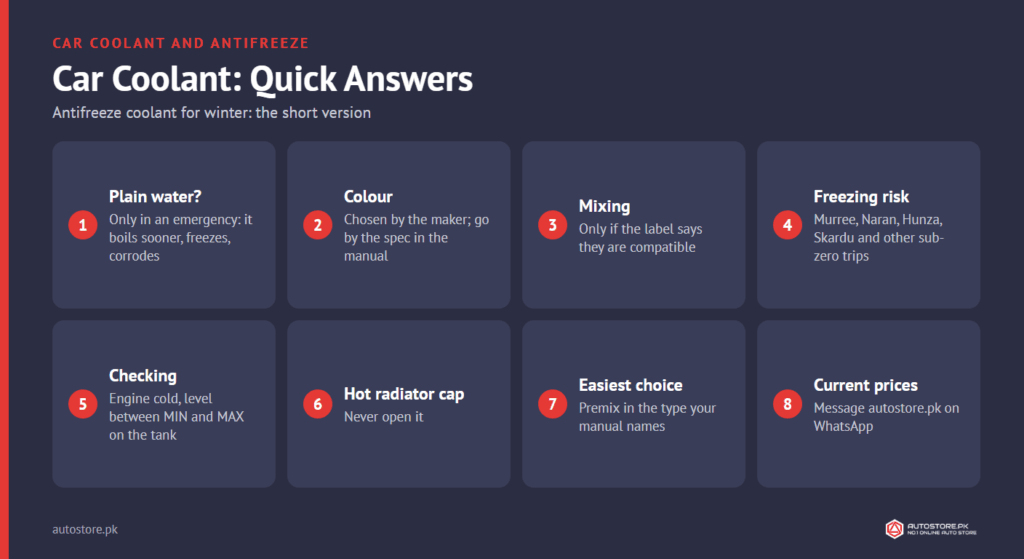
Buy the coolant type your owner’s manual names, in premix form if you would rather not measure. Ignore the colour. Then check the level in the see-through expansion tank with the engine cold, and keep your hands off a hot radiator cap. Then, if a trip north is on the cards, make sure the radiator holds a proper antifreeze coolant for winter and not a summer of tap-water top-ups.
| Question | Quick answer |
|---|---|
| Can I use plain water? | Only in an emergency. It boils sooner, freezes and corrodes the system. |
| Does colour tell me the type? | No. The maker chooses the colour. Go by the specification in the manual. |
| Can I mix two coolants? | Only if the label says they are compatible. Wrong mixes can gel. |
| When does freezing matter? | Trips to Murree, Naran, Hunza, Skardu and other places that drop below zero |
| How to check safely | Engine cold, read the expansion tank between MIN and MAX |
Antifreeze Coolant for Winter: What to Look For on the Label
Once you know the type, the choice is bottle size and premix or concentrate. A 1 litre bottle covers a top-up. A full refill takes several litres, so a 4 litre pack makes more sense. Not every product page gives the bottle size, so ask us on WhatsApp if it is missing. These come from our coolants and antifreeze category.
| Coolant at Autostore.pk | Key details |
|---|---|
| Carrera Long Life Green Coolant 1 L (Heat-Preventive) | Also sold in red. No freeze rating stated. |
| Carrera Long Life Green Coolant 1 L (Anti-Freeze) | Also sold in red. Freeze rating not stated. |
| Honda Coolant Premix | Premixed. Ask us for the bottle size. |
| Carrera Long Life Green Coolant 4 L (Heat-Preventive) | Also sold in red |
| Caltex Havoline Xtended Life Coolant | Organic additive type. 250,000 km or 5 years of protection. |
| Carrera Long Life Green Coolant 4 L (Anti-Freeze) | Also sold in red |
| Liqui Moly Radiator Antifreeze RAF 11, 1 L | Concentrate. Mix with water as directed. |
| Liqui Moly Radiator Antifreeze Coolant RAF 12, 1 L | Ready-to-use OAT mix for aluminium engines |
| Mobil Coolant Ready Mix | Premixed. Protection down to -36°C. |
| Toyota Coolant (Thailand), 4 L | Pink 50/50 premix. Freeze to -37°C, boil to 108°C. 40,000 km or 24 months. |
| AMSOIL 50/50 Long Life Coolant, Cars and SUV | Premixed 50/50. Freeze to -34°F (about -37°C). 5 years. |
For current prices on these, message autostore.pk on WhatsApp.

Premix or Concentrate: Read the Label
Two words on the label matter most. First, “premix” or “ready mix” already contains water, so do not dilute it again. Second, premixes vary in strength. Kixx RA Coolant, for example, is a premix with 80% water, which gives far less frost cover than a 50/50 mix. If you need antifreeze cover for winter, look for a freezing point printed on the bottle.
Where to Buy Coolant in Pakistan
Petrol station shops, the parts market, the dealer and online stores all sell coolant. The dealer sells the car maker’s own coolant, the safest match for a car under warranty. Online, you can compare specifications before you pay. Our car care and maintenance range covers coolant, and the oils and additives range has radiator flush and water pump lubricant. Wherever you buy, check the seal. Then look for the type, the mix and a batch or expiry date on the bottle.
What Antifreeze Coolant Does in Summer and Winter
Coolant is water and antifreeze, usually ethylene glycol, plus a pack of additives. It flows through the engine, picks up heat and carries it to the radiator, where air cools it down. Water can do that part on its own. The rest needs the glycol and the additives:
- Raises the boiling point. A 50/50 mix in a sealed, pressurised system boils far above plain water. AMSOIL 50/50 Long Life Coolant gives boil-over protection up to 265°F (about 129°C) with a 15 psi cap, and that margin saves you in a 45°C jam on Shahrah-e-Faisal.
- Lowers the freezing point. The 50/50 mixes in our range carry ratings of around -36°C to -37°C, against 0°C for water.
- Stops corrosion. The additives protect aluminium, iron, copper and rubber parts from rust and scale. In most of Pakistan this is the job that counts most, all year round.
- Protects the water pump. Coolant lubricates the pump seal and helps prevent cavitation damage from tiny bubbles that pit metal surfaces.
So coolant matters in Lahore and Karachi too. If your car runs hot in summer, read our guide on why cars overheat in Pakistani summer. Hybrid owners should also read our guide on which coolant to pour in a hybrid, because hybrids often have more than one cooling circuit.
Can You Use Plain Water?
Water will cool the engine, and the car will run. However, it boils earlier, freezes in the north and has no corrosion protection. The calcium, magnesium and iron in tap water also react with engine metals, and over time they build up scale that can block cooling passages and cause overheating. This explainer on why tap water harms the cooling system goes into the chemistry. If you buy concentrate, mix it with distilled water.
An emergency and a habit are two different things. A hose bursts near Kallar Kahar, you pour in water (distilled if you have it) and you limp to the next town: fine. Months of tap water is what leaves a radiator brown and blocked. So if you have been running on water, flush the system before you fill it with antifreeze coolant for winter.
Coolant Colours and Types: Why You Cannot Mix Them
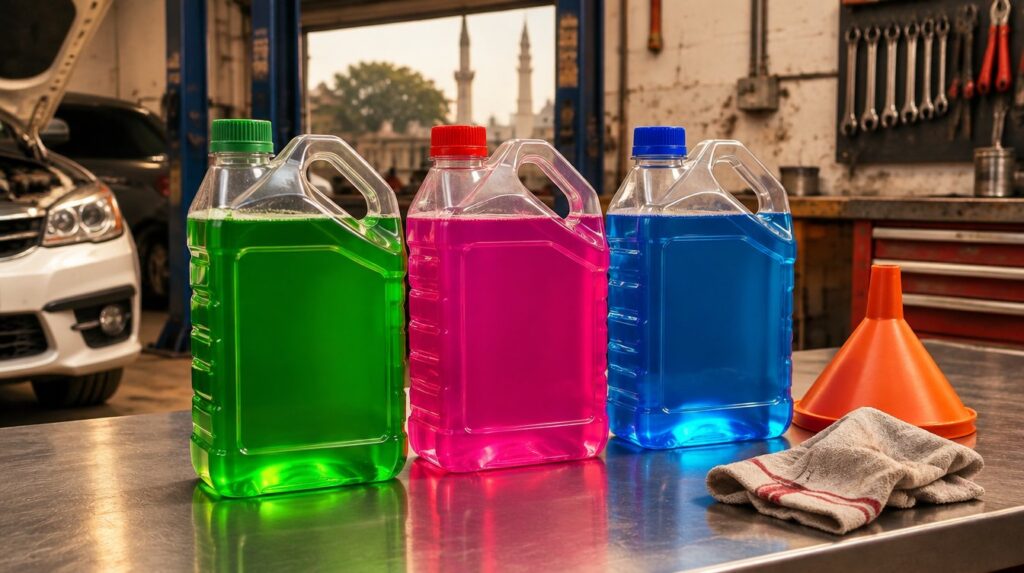
Coolant comes in green, red, pink, orange, blue and yellow, and plenty of drivers read the colour as the type. It tells you very little. Today the colour has more to do with the manufacturer than the antifreeze inside, because it is a dye the maker chooses and no standard governs it. So colour alone cannot confirm whether a coolant suits your engine.
The chemistry decides it, meaning the additive package that fights corrosion. Match yours against the main families:
| Type | Additive family | Colour often seen | What it usually suits |
|---|---|---|---|
| IAT | Inorganic additive technology (traditional) | Traditionally green | Older cars and older local models. Shorter life. |
| OAT | Organic acid technology | Often orange or red | Many modern cars with aluminium engine parts. Long life. |
| HOAT | Hybrid organic acid technology | Varies by maker | Mixed: some European and Asian cars |
| P-HOAT / POAT | Phosphated organic acid technology | Varies. Toyota’s own coolant is pink. | Many Japanese and Korean cars, hybrids, newer engines |
Why Mixing Coolant Types Causes Gel
Two different families can react when you mix them. Fill a radiator with both IAT and OAT coolant and you can end up with a gel that clogs the cooling system, as this guide to antifreeze colours and mixing explains. Mixing can also weaken the corrosion protection of both. Two coolants of the same colour can be different types, and two of different colours can be the same type. So go by the specification in your owner’s manual, the label on the reservoir or the coolant your dealer uses. That rule covers the Corolla, City, Civic, Swift, Aqua and Vitz too.
Bought the car second-hand and have no idea what is in it? Then the safe move before winter is a full flush and a fresh fill with one known antifreeze coolant, because topping up with a different type is how gel and sludge start.
Antifreeze Coolant for Winter Trips to the Northern Areas
In Lahore, Karachi or Islamabad, your coolant will not freeze. Up north, it can. On 10 January 2026 Skardu hit minus 13°C, Gupis minus 10°C, and Hunza and Gilgit minus 8°C. By 29 January, parts of Gilgit-Baltistan had dropped below minus 15°C after snowfall. Murree, Galyat and Naran also go below zero on winter nights.
Water expands when it freezes. A radiator, heater core or engine block full of water left out overnight in Skardu can crack, and that is an expensive repair a long way from a workshop. Before a winter trip north, run through these antifreeze coolant checks:
- Make sure the system holds real coolant with a printed freeze rating. If you cannot tell, a mechanic can test it with a coolant tester.
- Lots of water top-ups mean a weak mix, so drain and refill before you go.
- Use a 50/50 premix if you would rather not measure. For a concentrate, follow the ratio on its bottle and in your manual.
- Park with the nose out of the wind where you can, and let the engine warm up gently in the morning.
Antifreeze coolant is one item on a longer winter list. Our northern areas road trip kit covers what else to pack, and the winter car prep checklist covers the whole car. Cold mornings also test the battery hard, so check our guide to car battery prices and brands in Pakistan before you leave.
How to Check Your Antifreeze Coolant Safely Before Winter
Safety first: never open the radiator cap or the expansion tank cap on a hot engine. The cooling system is under pressure, and opening it hot can spray scalding coolant over your hands and face. So wait until the engine is cold, ideally first thing in the morning before the school run. The AMSOIL bottle carries the same warning on its label.
- Park on level ground and let the engine cool fully.
- Find the see-through plastic expansion tank, also called the reservoir or overflow bottle. Your manual shows where it sits.
- Read the level against the MIN and MAX (or LOW and FULL) marks. Coolant expands when hot, so only a cold reading is accurate.
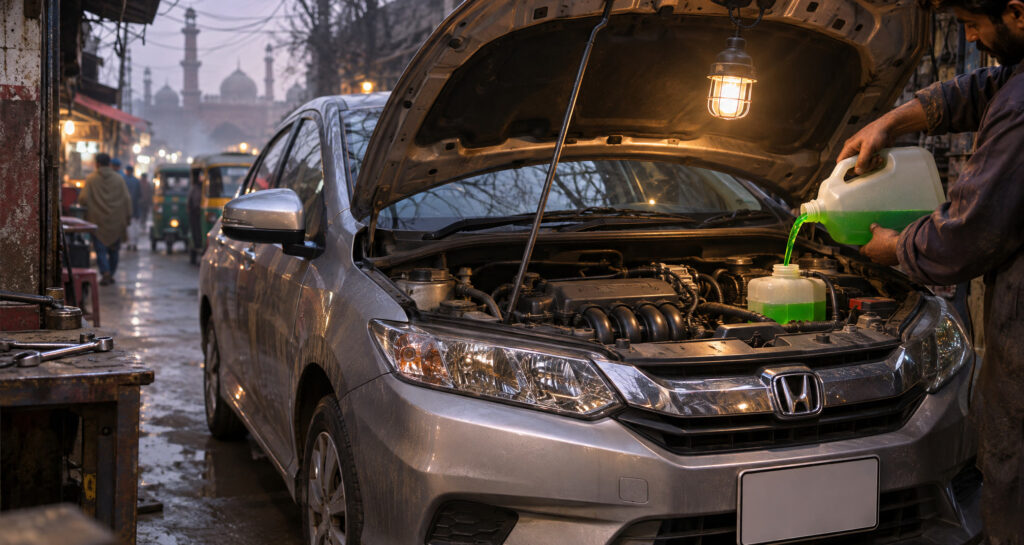
- If it is below MIN, slowly open the expansion tank cap with a cloth over it. Then add the same coolant up to MAX, and do not overfill.
- Next, look at the colour. You want clear and bright. Brown, rusty, oily or full of bits means trouble.
- Finally, close the cap firmly. If you had to add a lot, check again after a few days of driving.
Our older step-by-step guide on how to check and top up coolant has more detail for first-timers. If the engine oil is also due, read about choosing the right engine oil in Pakistan at the same time.
When to Flush and Refill Coolant
Coolant wears out, because its additives get used up, and once they are gone the coolant stops protecting the metal even though the tank still looks full. The right interval is in your owner’s manual, because it depends on which coolant type your car needs. Long-life coolants last much longer than old green coolant. For example, our Toyota coolant is rated for 40,000 km or 24 months, while Caltex Havoline Xtended Life states 250,000 km or 5 years. Trust the manual over the boldest claim on any bottle.
Signs Your Coolant Needs Changing Sooner
Flush early if you notice any of these.
| What you notice | Likely cause | What to do |
|---|---|---|
| Temperature needle climbs, or the engine overheats in traffic | Low coolant, a leak, a stuck thermostat, a weak fan or a blocked radiator | Stop, let it cool, check the level. Have the system tested. |
| Sweet, syrupy smell from the bonnet or inside the cabin | Coolant leaking onto hot parts, or a leaking heater core | Look for wet hoses and drips. See a mechanic soon. |
| Level keeps dropping | A leak, a faulty cap, or in bad cases a head gasket problem | Pressure-test the system. Do not keep topping up. |
| Brown, rusty or muddy coolant | Worn-out additives, years of tap water, or internal rust | Flush and refill with the right coolant |
| Jelly-like sludge or oily film in the tank | Mixed coolant types, or oil getting into the coolant | Flush. If oil is present, have the head gasket checked. |
A proper flush drains the old coolant, cleans the system and refills it with fresh coolant and no trapped air. Our guide on how to flush a radiator without damaging it explains each step. You will find radiator flush products and water pump lube in our oil additives section. Stop-leak products can seal a tiny seep for a while. Treat a bottle of it as a ticket to the nearest workshop, where the leak still needs fixing.