Your engine is screaming for help, but you can’t hear it. The wrong oil breaks down under Lahore’s summer heat. Metal grinds against metal. Wear accelerates. Years get shaved off your engine’s life, and you won’t know until it’s too late.
Engine oil is not just there to keep things smooth—it plays a huge role in how long your engine stays healthy. With Pakistan’s extreme heat, dusty roads, and nonstop city traffic, your engine takes a proper beating. Using the wrong oil might save you a little money now, but it can lead to expensive mechanic bills later.
This guide keeps things simple and tells you everything you need to know about engine oils.
Understanding Engine Oil Grades and What They Mean
The Numbers Explained: 5W-30, 10W-40, 20W-50
Those numbers tell you how thick the oil is at different temperatures. The first number (before the W) indicates viscosity at cold temperatures. The W stands for winter. Lower numbers flow better in cold conditions. The second number indicates viscosity at high temperatures. Higher numbers mean thicker oil at operating temperature.
5W-30 flows easily when cold and stays moderately thin when hot. Good for newer engines with tight tolerances. 10W-40 is thicker, works well for older engines and hotter climates. 20W-50 is thick oil for high-mileage engines or extreme heat.
Which Grade Suits Our Climate Best?
Pakistan’s heat is no joke. We’re talking 45°C and beyond in most cities during summer. That kind of heat makes oil run thinner, which means less protection for your engine. You want something that stays thick enough to do its job even when the temperature’s through the roof.
If you bought your car in 2015 or later, go with 5W-30 or 5W-40. These newer models have engines designed differently, with parts that fit much tighter together. They need oil that can move around easily without being too heavy.
Got something from 2005 to 2015? Then 10W-40 is your best bet. It handles the heat without getting too thin, but it’s still light enough to keep everything running smoothly.
Now, if your ride is older than 2005 or has high mileage, you’re better off with 15W-40 or 20W-50. Engines wear down over time. Parts don’t fit as snugly as they used to, and thicker oil does a better job filling those gaps. Notice your car eating up oil between changes? Seeing blue smoke when you start up? That’s your sign to switch to something thicker.
Synthetic vs Semi-Synthetic vs Mineral Oil
Mineral oil is derived directly from refined crude petroleum. It’s the cheapest option and works fine for basic needs. Breaks down faster in extreme heat and needs more frequent changes.
Semi-synthetic blends mineral oil with synthetic components. Better heat resistance than pure mineral oil at a reasonable price. This is where most Pakistani drivers should shop.
Full synthetic oil is lab-engineered for maximum performance. Handles extreme temperatures better, lasts longer between changes, and protects better under stress. Costs significantly more but pays off in engine longevity and performance.
API and ILSAC Ratings
Check the bottle for API ratings before you buy. API stands for American Petroleum Institute.
You’ll see letters like SN, SP, or SN Plus. The further along the alphabet, the better the standard. Basically, higher letters mean the oil meets tougher requirements and better protects your engine.
Then there’s ILSAC, which stands for the International Lubricant Standardization and Approval Committee. Their ratings look like GF-5 or GF-6. These indicate that the oil is designed to save fuel.
Top Engine Oil Brands You’ll Find in Pakistan
Liqui Moly: German Engineering at Premium Prices
Liqui Moly sits at the top of the premium oil market here. It’s made in Germany with tight quality checks. Independent testing backs up what they claim, and the stuff actually works.
Here’s what people usually buy:
- Leichtlauf High Tech 5W-40 costs Rs 3,500–4,200 for 4 liters. This synthetic oil is perfect for newer European and Japanese cars. It handles our crazy heat without breaking a sweat.
- MoS2 Leichtlauf 10W-40 costs Rs 2,800–3,400 for 4 liters. It’s semi-synthetic, with molybdenum disulfide added for extra wear protection. Works wonders if your engine’s racked up serious kilometers.
- The Optimal 10W-40 is their cheaper option, priced at Rs 2,200 to Rs 2,800 for 4 liters. Still meets German quality standards even though it won’t drain your wallet as badly.
Yes, Liqui Moly costs more than local stuff. But you’re getting better additives, stricter manufacturing, and oil that actually matches what’s written on the bottle.
Mobil: Global Brand with Strong Reputation
Everyone knows Mobil. Quality usually stays consistent, but fakes are everywhere, so watch where you buy.
What they offer:
- Mobil 1 5W-30 goes for Rs 3,800 to Rs 4,500 for 4 liters. Full synthetic built for newer engines. Protects well in heat and lasts longer between changes.
- Mobil Super 3000 5W-40 runs Rs 2,400 to Rs 3,000 for 4 liters. This semi-synthetic handles Pakistani weather perfectly. Civic and Corolla owners love this one.
- Mobil Super 2000 10W-40 costs Rs 1,800 to Rs 2,300 for 4 liters. It’s mineral-based, made for older cars or folks on tight budgets.
The best thing about Mobil is you can find it anywhere, and every mechanic knows it. The problem? Fake bottles are everywhere. Only buy from authorized dealers unless you want to gamble with what’s actually inside.
Kixx: Korean Quality at Competitive Prices
Kixx has really taken off here in the last few years. Made by GS Caltex in Korea, these oils perform well and cost less than the big premium names.
Their range:
- Kixx G1 5W-40 sells for Rs 2,800 to Rs 3,400 for 4 liters. Fully synthetic with great heat resistance. Japanese and Korean cars run beautifully on this.
- Kixx Gold 10W-40 is Rs 1,600 to Rs 2,000 for 4 liters. Semi-synthetic that withstands our heat. You get a lot for your money with this one.
- Kixx Dynamic 20W-50 goes for Rs 1,200 to Rs 1,600 for 4 liters. Mineral oil for older rides with high mileage.
Kixx gives you solid performance without charging premium prices. Can’t afford Liqui Moly or Mobil but want better than local brands? Kixx is your answer. Quality stays good, and fakes aren’t as common since it’s cheaper to begin with.
Caltex Havoline: Trusted American Brand
Havoline’s been around Pakistan for decades. People trust it, and you can find it through tons of dealers. Quality doesn’t vary much from batch to batch.
What they’ve got:
- Havoline Fully Synthetic 5W-30 costs Rs 3,200 to Rs 3,800 for 4 liters. Modern synthetic for newer engines that also helps with fuel economy.
- Havoline ProDS 10W-40 runs Rs 1,900 to Rs 2,400 for 4 liters. Semi-synthetic with strong additives, specifically formulated for conditions like ours.
- Havoline Super 4T 20W-50 is Rs 1,400 to Rs 1,800 for 4 liters. Mineral oil that does the job fine for older cars and motorcycles.
Havoline lands somewhere in the middle. Not quite as fancy as Liqui Moly, but more established than the Korean brands. Smart pick if you want something reliable without paying top dollar.
Shell Helix: Global Giant with Local Presence
Shell doesn’t need an introduction. Their Helix range covers everything from basic mineral oils to advanced synthetics. You’ll find it everywhere, but random shops often sell fakes.
The Helix lineup:
- SHELL HELIX ULTRA 5W-40 costs Rs 3,600 to Rs 4,200 for 4 liters. Full synthetic with their PurePlus technology. Great protection for performance cars and newer engines.
- Shell Helix HX7 10W-40 is Rs 2,200 to Rs 2,700 for 4 liters. Semi-synthetic that nicely balances protection and cost.
- Shell Helix HX3 20W-50 runs Rs 1,300 to Rs 1,700 for 4 liters. Basic mineral oil for older vehicles when you’re watching your budget.
Shell dumps tons of money into research and development. You can tell in how their oils perform. Prices match other international brands pretty closely.
Total Quartz: French Technology
Total Quartz showed up in our market more recently but caught on fast—quick engineering with solid specs and competitive pricing.
Total offers:
- Total Quartz 9000 5W-40 goes for Rs 2,900 to Rs 3,500 for 4 liters. Fully synthetic with excellent protection when temperatures climb.
- Total Quartz 7000 10W-40 costs Rs 1,800 to Rs 2,300 for 4 liters. Semi-synthetic for regular daily driving.
- Total Quartz 5000 20W-50 is Rs 1,200 to Rs 1,600 for 4 liters. Mineral oil for basic requirements.
It gives you good bang for your buck, especially their semi-synthetic stuff. They’re not as well-known here as Shell or Mobil yet, but the quality holds up just fine.
How to Avoid Fake Engine Oil
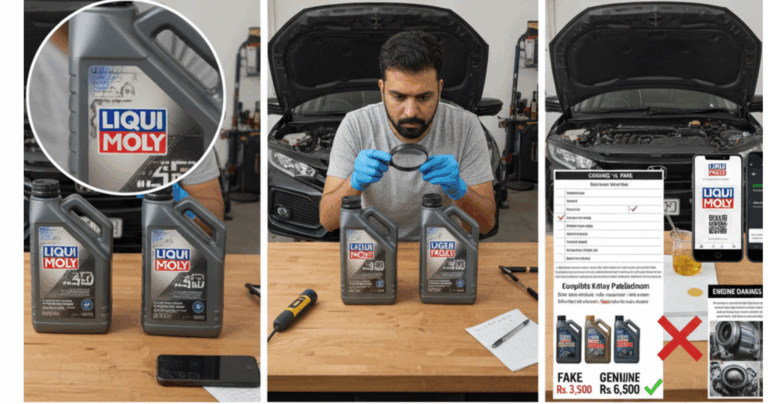
Fake engine oil is a real issue in Pakistan, especially with expensive brands. These copies may look convincing, but the oil inside is often low quality and can seriously mess with your engine over time.
The safest move is to buy from authorized dealers or trusted auto stores. You might pay a little more than a random roadside shop, but at least you know you are not pouring mystery oil into your car.
Check the bottle too—original products usually have clean printing, proper labels, batch numbers, manufacturing dates, holograms, and a sealed cap. If the text looks blurry, the label is badly stuck on, or there are spelling mistakes, that is a major red flag.
Are Engine Additives Worth Your Money or Just Hype?
Engine Flush Products
You’ve probably seen bottles like Liqui Moly Engine Flush that claim to wash out sludge and gunk before you change your oil. Do they actually work? Sometimes, yeah.
If you pop open your oil cap and see nasty sludge buildup, or if you’ve been lazy about oil changes, a flush might help. But if you’ve been changing your oil on schedule, these products won’t do much for you. They might even loosen up deposits that were sitting there harmlessly, which can cause new problems.
Oil Additives and Supplements
Shops sell all kinds of stuff that supposedly reduces friction, restores compression, or makes your oil last longer. Most of it’s pointless if you’re already using decent oil.
Quality engine oil comes packed with additives that are carefully mixed to work together. Throw in random supplements, and you risk messing up that balance. Sometimes you’ll actually make things worse instead of better.
The one exception? High-mileage additives designed to plump up old seals and stop oil burning. Products like Liqui Moly Oil Saver or similar products can help older engines that burn through oil too quickly. Just remember, you’re covering up the problem, not fixing worn-out parts.
Octane Boosters and Fuel Additives
These aren’t oil additives, but you’ll see them on the same shelf. Some fuel additives really do clean your injectors and help combustion. Most octane boosters, though? Overpriced junk that doesn’t deliver.
Need higher octane? Just fill up with premium fuel. Injectors feeling clogged? Use a proper fuel system cleaner once every 10,000 km and call it a day.
Where to Buy Engine Oil in Pakistan
Brand dealerships for Toyota, Honda, Suzuki, and others sell genuine oil. You’ll pay close to retail price with no discounts, but authenticity is guaranteed—a good option when getting service done at the dealership.
Autostore.pk sources directly from brands and authorized distributors: good selection, competitive pricing, and much lower risk of fakes than at random shops.
Common Engine Oil Mistakes to Avoid
Mixing Different Oil Brands
Mixing brands is generally okay if they’re the same grade and specification. Oil from different brands uses different additive packages, but they’re designed to be compatible.
That said, avoid mixing if possible. Stick with one brand and grade for consistency.
Mixing Synthetic and Mineral Oil
You can mix synthetic and mineral oil in emergencies. It won’t cause immediate damage. But the synthetic oil’s benefits get diluted, and you’re essentially creating your own semi-synthetic blend with unknown properties.
Only mix in genuine emergencies when you’re far from help and desperately need oil. Otherwise, drain and refill properly.
Ignoring Oil Pressure Warning Light
If your oil pressure light comes on while driving, stop immediately. Low oil pressure means metal parts aren’t getting lubrication. Continuing to drive can destroy your engine in minutes.
Pull over safely, turn off the engine, and check oil level. If the level is fine but the light stays on, you have a serious problem. Don’t drive further. Get towed.
Future of Engine Oil in Pakistan
Electric Vehicles and Reduced Oil Demand
As electric vehicles slowly enter Pakistan’s market, engine oil demand will eventually decline. EVs don’t have combustion engines and don’t need traditional engine oil.
But this shift will take decades. Pakistan’s vehicle fleet turns over slowly, and EVs remain expensive. Traditional engine oil will stay relevant for at least another 20 years.
Stricter Fuel Quality Standards
If Pakistan ever enforces proper fuel quality standards with lower sulfur content, oil life will improve significantly. Better fuel means less contamination and longer-lasting oil.
Don’t hold your breath waiting for this change, but it would make a real difference if it happens.
FAQs: Best Engine Oil in Pakistan
Can I switch from mineral oil to synthetic oil in an older engine without causing problems?
Yeah, you can switch without any problems in most cases. That old story about synthetic oil causing leaks in older engines? Complete nonsense.
What actually happens is this: synthetic oil cleans better than mineral oil. So if you’ve got a leak that was being plugged up by built-up sludge, the synthetic will wash that away, and the leak shows up. It’s not creating the leak, just exposing one that was already there.
If your engine’s been running fine on mineral oil, switching to synthetic gives you better protection, especially in our heat. Just stick with the right thickness grade.
Now, if you’ve got a really ancient engine that’s seriously worn out, it might run better on thicker mineral oil. But for most cars, switching to synthetic oil is perfectly safe and can actually help your engine.
Why does my car burn or consume oil between changes, and what can I do about it?
Oil disappears for a few different reasons. When piston rings wear out, oil sneaks into the combustion chamber and gets burned up. Bad valve seals let oil drip down through the valve guides. Then there are plain old leaks from gaskets or seals, where oil drips out without burning.
Losing a bit of oil between changes is actually normal. Under half a liter? Don’t stress about it, especially if your car’s got some age or serious kilometers on it.
But if you’re constantly topping up, try switching to something thicker first. Go with 15W-40 or 20W-50. This helps worn engines seal better. You can also add high-mileage additives to soften the seals.
Still burning through oil even after going thicker? That means parts inside are properly worn out. At that point, you need a mechanic to open things up and fix what’s broken.
Is it better to change oil based on kilometers driven or time elapsed, and why does it matter?
Both distance and time count here. Oil breaks down from driving and from just sitting there doing nothing. Drive a lot? Go by your odometer. Car mostly parked? Change it based on time even if you haven’t hit the kilometer mark yet.
Oil that sits in an engine soaks up moisture from condensation. The additives in it also break down over time, whether you’re driving or not.
For our conditions, change your oil every 5,000 km or every 6 months, whichever hits first.
The Bottom Line
Most Pakistani drivers should buy semi-synthetic 10W-40 oil from a reputable mid-tier brand like Kixx, Caltex Havoline, or Shell Helix HX7. This combination offers good protection at a reasonable cost, without the risks of ultra-budget oils or the expense of full-synthetic oils.
Change it every 4,500 to 5,500 km regardless of what the manual says. Our conditions demand shorter intervals.
If you drive a newer car (2015+), especially with a turbo, step up to full synthetic 5W-30 or 5W-40. The extra cost prevents expensive repairs down the road.
Buy from authorized dealers or specialized automotive stores, such as Autostore.pk, to avoid counterfeit products. The convenience and peace of mind are worth any slight price premium.
Your engine is the most expensive component in your car. Proper oil maintenance is the cheapest insurance you can buy. Don’t cheap out trying to save a few hundred rupees per change. The engine repair bills later will cost hundreds of thousands.