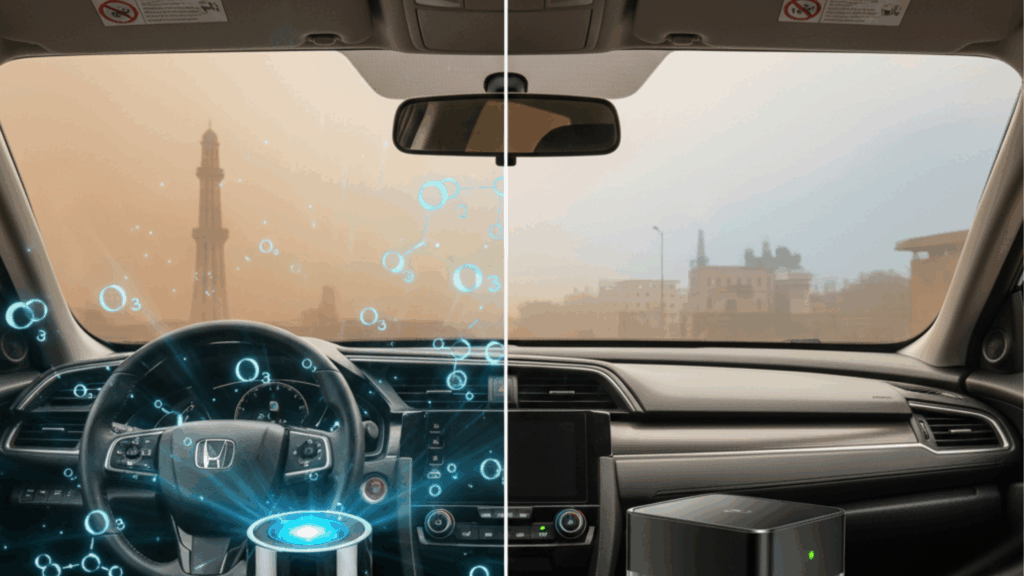
Let me be straight with you. Anyone who’s driven around Lahore during the winter months has lived through it – that nasty grey haze that sits there like a dirty blanket over the city. You’ve seen it. That smog is so thick you almost want to turn on your wipers to see if they’ll somehow help (spoiler: they won’t). Your eyes start stinging. Your throat gets scratchy and dry, like you swallowed a handful of dust. And the worst part? All that filth is getting inside your car while you’re just sitting there in traffic.
Most of us try the usual tricks. Roll up the windows. Blast the AC. Hit that recirculation button and think we’ve outsmarted the pollution. But really? All you’re doing is breathing the same dirty air round and round. Not quite the brilliant solution it seemed to be.
So naturally, you start researching car air purifiers. Good call. Then the nightmare begins. One website tells you HEPA filters are a must. Another swears by ozone generators. Someone mentions ionizers. There’s talk about activated carbon and PM2.5 levels, and before you know it, your brain hurts worse than it does sitting in Ferozepur Road traffic at 8 AM.
Trust me, I understand the confusion. That’s exactly why I sat down to write this whole thing out – no marketing fluff, no sales pitch nonsense. Straight talk about what actually works on Pakistani roads, what’s a waste of money, and what you should actually go out and buy for your car.
The Lahore Smog Situation: Why Your Car Needs More Than Just AC
The smog isn’t just one thing. It’s a toxic cocktail of:
PM2.5 and PM10 particles – These are tiny particulate matter smaller than 2.5 and 10 microns. To put that in perspective, a human hair is about 70 microns thick. These particles are so small that they bypass your nose’s natural filters and go straight into your lungs. Some even enter your bloodstream. Fun times.
Vehicle emissions – All those rickshaws, buses, trucks, and cars (yes, including yours) pumping out nitrogen dioxide, carbon monoxide, and unburned hydrocarbons.
Industrial pollution – Factories that don’t care about emission standards because, let’s be honest, enforcement is a joke.
Crop burning smoke – Our lovely neighbors across the border and our own farmers are burning crop residue. The smoke travels hundreds of kilometers and settles right over our cities.
Construction dust – Because apparently, every road in Lahore is perpetually under construction.
That’s where proper air purification comes in. But before you rush to Daraz or drop by your local car accessories shop, you need to understand what you’re actually buying.
Understanding HEPA Filters: The Gold Standard (When Done Right)
HEPA stands for High-Efficiency Particulate Air. It’s not a brand name – it’s a standard. A true HEPA filter must capture at least 99.97% of particles that are 0.3 microns in size.
How HEPA Filters Actually Work
Think of a HEPA filter like an extremely dense maze made of randomly arranged fibers. When air passes through, particles get trapped through three mechanisms:
Interception – Particles following the air stream come within one particle radius of a fiber and stick to it.
Impaction – Larger particles can’t follow the air stream’s curves and slam straight into the fibers.
Diffusion – The smallest particles bounce around randomly (Brownian motion) and eventually hit a fiber.
The result? Clean air coming out the other side. No chemicals, no byproducts, just physical filtration.
The Good Stuff About HEPA
It actually removes particles. This isn’t some vague “purification” claim. HEPA physically captures the nasty stuff. PM2.5, PM10, pollen, mold spores, bacteria – all trapped.
No harmful byproducts. Unlike some other technologies (looking at you, ozone generators), HEPA filters don’t create anything new. They remove what’s already there.
Proven technology. HEPA filters have been used in hospitals, clean rooms, and aircraft for decades. The science is solid.
Good for allergies. If you’re one of those people who start sneezing the moment dust settles anywhere near you, HEPA is your friend.
The Not-So-Good Stuff
They don’t remove odors. A HEPA filter can trap a smoke particle, but it can’t do anything about the smell. That’s why good air purifiers combine HEPA with activated carbon filters.
Not all “HEPA” filters are real HEPA. The market is full of “HEPA-type” or “HEPA-like” filters that don’t meet the actual standard. If it doesn’t say “True HEPA” or “H13 HEPA,” be suspicious.
Understanding Ozone Generators: The Controversial Option
Ozone (O₃) is a molecule made of three oxygen atoms. Regular oxygen (O₂) has two. That extra atom makes ozone highly reactive – it wants to give away that third oxygen atom to pretty much anything it encounters.
How Ozone Purifiers Work
Ozone generators use either UV light or corona discharge to break apart oxygen molecules (O₂) and create ozone (O₃). The ozone then reacts with pollutants, odors, bacteria, and viruses, theoretically neutralizing them.
The marketing sounds great. “Eliminates odors at the molecular level!” “Kills 99.9% of bacteria!” “Hospital-grade disinfection!”
But here’s where things get complicated.
The Good Stuff About Ozone (Yes, There Is Some)
It kills bacteria and viruses. Ozone is legitimately effective at destroying microorganisms. Hospitals use ozone for deep disinfection of rooms – after evacuating everyone.
It eliminates odors. Not just masks them – actually breaks down the molecules causing the smell. Cigarette smoke, food odors, mildew – ozone can handle them.
It penetrates everywhere. Because it’s a gas, ozone reaches places physical filters can’t – into upholstery, carpet fibers, dashboard cracks, AC vents, and all the hidden corners where smells hide.
So Which One Should You Buy? (The Answer Might Surprise You)
Here’s where I’m going to save you potentially thousands of rupees and a lot of frustration.
For Lahore smog, HEPA filters are non-negotiable. Period. End of discussion.
Why? Because Lahore’s main problem is particulate matter. The smog that makes you choke, burns your eyes, and causes long-term health problems is made up of tiny particles. Ozone does absolutely nothing to remove these particles.
The Ideal Setup for Pakistani Conditions
The best car air purifiers for our conditions use a multi-stage filtration system:
Pre-filter – Catches larger particles like dust, hair, and visible debris. This extends the life of your HEPA filter. You can usually vacuum or wash these.
True HEPA filter – The main event. Captures 99.97% of particles down to 0.3 microns. This is what protects you from PM2.5 and PM10.
Activated carbon filter – Made from charcoal treated to be extremely porous. One gram of activated carbon can have a surface area of 500-3,000 square meters. It absorbs gases, odors, and VOCs (volatile organic compounds) through a process called adsorption.
Optional: UV-C light – Some units include a UV lamp that kills bacteria and viruses as they pass through the filter. It’s a bonus feature, not essential, but nice to have.
Some people ask about ionizers. These create negative ions that attach to particles, making them heavier so they fall out of the air or stick to surfaces. They’re okay as a supplementary feature, but shouldn’t be your primary filtration method. Also, some ionizers produce small amounts of ozone as a byproduct, which brings us back to the problems we just discussed.
What to Look for When Buying a Car Air Purifier in Pakistan
Shopping for car accessories in Pakistan is always an adventure. The market is flooded with cheap Chinese imports, convincing-looking knockoffs, and products with wildly exaggerated claims. Here’s how to separate the wheat from the chaff.
Must-Have Features
True HEPA certification – Listen, don’t let companies fool you with fancy words like “HEPA-type” or “HEPA-like.”
That’s clever marketing speak for cheap knockoffs that won’t do the job properly. What you actually want to see is “True HEPA,” “H13 HEPA,” or “Medical Grade HEPA” written clearly on the box.
Here’s a simple rule: if the seller is being vague about the HEPA grade or avoiding mentioning it altogether, chances are it’s not the real deal.
CADR rating – This is basically how fast the purifier can clean your car’s air, measured in cubic meters per hour (m³/h). Your average car interior is roughly 3-4 cubic meters of space.
So you need something with at least 10-15 m³/h to actually make a difference. Going higher than that is even better, but here’s the catch – you don’t want something so powerful it kills your battery while you’re stuck in a jam on Mall Road. Balance is key.
Appropriate size – A purifier designed for a 200 sq ft room won’t work efficiently in your car, and a tiny USB-powered unit won’t do much either. Look for units specifically designed for car interiors.
Multiple fan speeds – You’ll want low speed for normal driving and high speed when you first get in the car or when air quality is particularly bad.
Power options – The most common is the 12V cigarette lighter port. Some newer models use USB-C, which is fine if you have a powerful enough adapter. Avoid battery-powered units for daily use – constantly recharging them is a pain.
Filter replacement indicators – Good units have a light or indicator that tells you when to change filters. Without this, you’re guessing, and a clogged filter is useless.
Noise level – You don’t want a unit that sounds like a helicopter taking off. Check reviews specifically mentioning noise at different fan speeds.
Red Flags to Avoid
No brand name or certification – If you can’t find the manufacturer’s website or any certification information, walk away.
Impossibly cheap – Real HEPA filters and proper air purifiers aren’t cheap to manufacture. If you’re seeing prices under Rs. 2,000, it’s either fake or useless. A decent unit starts around Rs. 5,000-8,000, and good ones are Rs. 10,000-20,000.
Ozone as the main feature – If “ozone generation” is prominently advertised as the primary purification method, hard pass. The only acceptable use of ozone in cars is during deep-cleaning sessions, when the car is empty and well-ventilated afterward.
Wildly exaggerated claims – “Eliminates 99.99% of all pollutants!” “Increases oxygen levels!” “Removes radiation!” If it sounds too good to be true, it definitely is.
No replacement filters available – This is a huge problem in Pakistan. You buy a purifier, it works great for three months, then the filter clogs up, and you can’t find replacements anywhere. Before buying, confirm that replacement filters are available locally or can be ordered online.
The DIY Upgrade: Improving Your Car’s Built-in Filtration
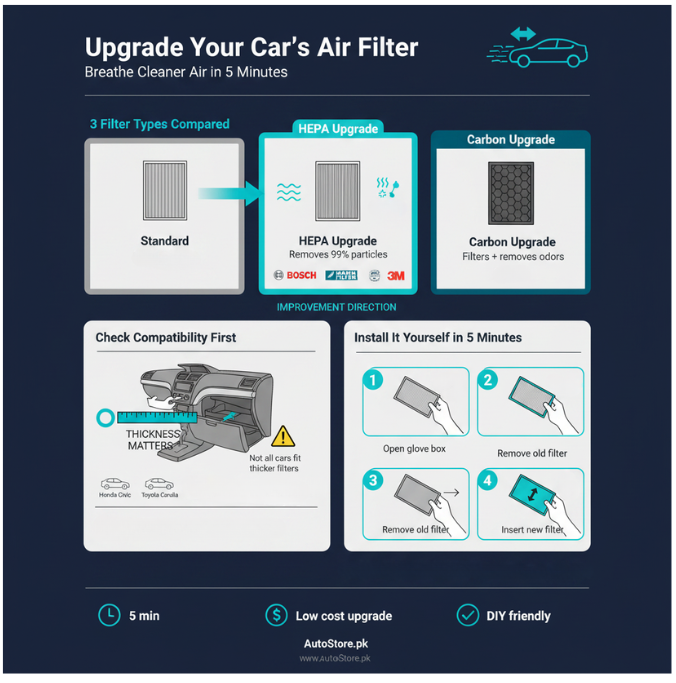
Most cars come with basic paper filters. But you can upgrade to:
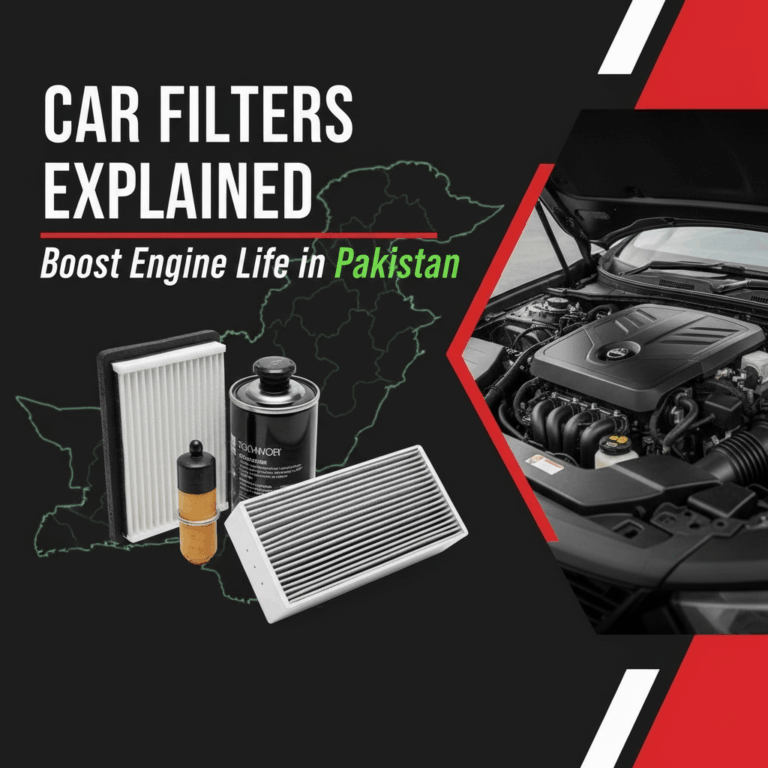
HEPA cabin filters – Yes, these exist for many car models. They’re thicker and more effective than standard filters. Brands like Bosch, Mann Filter, and 3M make them for popular models such as the Civic, Corolla, City, and others.
Activated carbon cabin filters – These combine particle filtration with odor removal. They cost 2-3x as much as basic filters but work brilliantly. Perfect if your car’s AC starts smelling musty during the monsoon season.
The catch? Not all cars can accommodate thicker HEPA or carbon filters due to the filter housing size. Check your car’s manual or ask at Autostore.pk – we can confirm compatibility for most models.
Changing your cabin filter is usually a 5-minute job you can do yourself. It’s behind the glove compartment in most cars. YouTube it for your specific model.
The Maintenance Reality (That Nobody Tells You)
Buying a car air purifier is like buying a pet. It needs care, feeding (in this case, filter replacements), and attention. Neglect it, and it either stops working or makes things worse.
Pre-filter cleaning: Every week during October-January smog season, every two weeks otherwise. Take out the pre-filter and vacuum it, or rinse it with water if washable. Let it dry completely before reinstalling. This simple habit extends your HEPA filter’s life by months.
Activated carbon replacement: The carbon layer is usually integrated into the HEPA filter, but some units have separate carbon filters. These need to be replaced every 6 months, though their odor-absorbing capacity decreases over time. If you notice smells getting through, the carbon is saturated.
Cost reality check: If your purifier costs Rs. 10,000 and replacement filters are Rs. 2,000 every 4 months, that’s Rs. 6,000 annually in maintenance. Factor this into your decision. A cheap purifier with expensive or unavailable replacement filters is a waste of money.
Where to Actually Buy Reliable Units in Pakistan
The market is messy, so here’s the reality of shopping in Pakistan:
Online marketplaces (Daraz, Amazon sellers, AliExpress): Hit or miss. Product descriptions are often copy-pasted nonsense with fake specifications. Reviews can be manipulated. Returns are a hassle. If buying online from marketplaces, only go with sellers who have thousands of positive reviews and offer verified products.
Autostore.pk: We stock certified purifiers with proper HEPA filters and activated carbon layers. More importantly, we have replacement filters in stock – not “available on order from China in 8-12 weeks.” We don’t sell ozone generators as primary car purifiers because we’re not in the business of selling things that can harm you.
FAQs: Car Air Purifier
Q: Can I use my car’s AC recirculation mode instead of buying a purifier?
Short answer? No, not really.
Look, I know what you’re thinking – recirculation mode is free, it’s already built in, so why spend money on something else? Makes sense on paper. But here’s what’s actually happening.
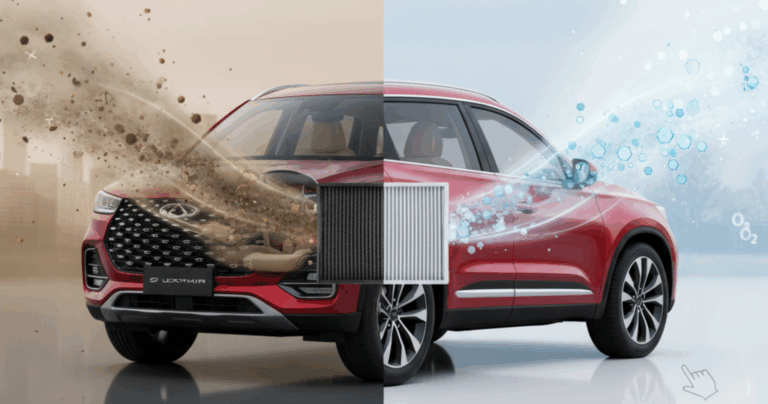
Your car’s AC system has a basic cabin filter. And I mean basic. It’s designed to catch leaves, bugs, and big chunks of dust – the obvious stuff. But those tiny PM2.5 particles everyone keeps talking about? The really nasty stuff that gets deep into your lungs? Your standard cabin filter lets most of that sail right through.
Now, if you’ve got a newer car with a premium cabin filter (some call them “activated carbon filters” or “HEPA cabin filters”), that’s better. But even those need replacing every few months, and most people forget or don’t bother because they’re expensive and annoying to change.
Bottom line: recirculation mode alone isn’t cutting it. Not in our pollution levels. You need something stronger.
Q: Will an air purifier drain my car battery?
A: Depends on the purifier, but honestly? Most won’t cause you problems if you’re using them right.
Here’s the deal. A decent car air purifier draws between 5 and 15 watts of power. To put that in perspective, that’s less than your phone charger, way less than your headlights, and nothing compared to what your AC sucks up. So when your engine’s running, it’s not even a blip on the radar. Your alternator handles it no problem.
The trouble starts when people leave them plugged in after turning off the car. You park outside the office, engine off, but the purifier’s still humming away through your 12V socket. Leave it like that for a few hours, and yeah, you might come back to a dead battery. Especially if your battery’s already old or weak – which, let’s be honest, describes half the cars in Pakistan.
So the rule is simple: unplug it when you park. Or get one with an auto shut-off feature that kills the power when it detects the engine’s off. Some of the smarter models do this automatically.
Also, don’t go crazy and buy some industrial-strength purifier meant for a room. Stick to ones actually designed for cars – they’re built to work within your car’s electrical limits.
Use it while driving? Zero issues. Leave it running in a parked car all day? You’re asking for trouble. Pretty straightforward.
Q: What’s the difference between a car air purifier and a home air purifier – can I use a small home unit in my car?
A: Look, you could try, but it’s a bad idea.
Home purifiers run on 220V wall power. Your car’s got 12V from the cigarette lighter. You’d need a power inverter to make it work, and it’ll drain your battery fast.
Plus, even small home units are too bulky to fit in a car. Where would you even put it? Dashboard? Cup holder? It’ll just slide around and take up space you actually need.
And here’s the thing – home purifiers aren’t built for bumpy roads and constant vibration. One pothole on Jail Road and you’ve got a rattling mess or a broken unit.
Just get the right tool for the job. Don’t jury-rig a home purifier into your car.
Final Thoughts
The choice between HEPA and ozone isn’t really a choice at all. HEPA removes what’s killing us (particulate matter), while ozone just adds another irritant. The marketing might confuse you, but the science is clear.
Invest in a proper HEPA-based system, maintain it properly, upgrade your cabin filter, and breathe easier. Your lungs will thank you, your family will benefit, and your daily commute will become slightly less of a health hazard.
.