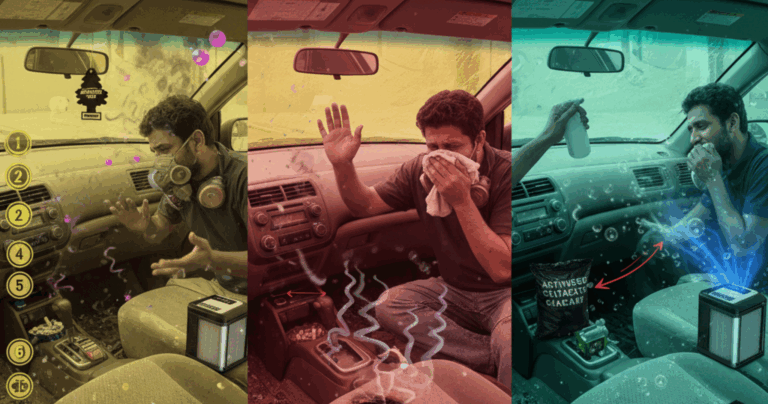
My uncle Nadeem chain-smokes in his 2019 Civic. Always has, probably always will. The problem isn’t really the smoking itself—that’s his choice—but what it does to his car’s interior. Last year, during a family wedding, he offered to drive some relatives from Karachi to the venue in Islamabad. Within twenty minutes of the four-hour journey, everyone was making excuses about needing fresh air, cracking windows despite the highway dust, and basically doing everything possible to avoid saying, “Uncle, your car smells like an ashtray.”
The embarrassment hit him hard. Here’s a successful guy, well-dressed, who drives a nice car, but the interior smells so strongly of stale cigarette smoke that people literally prefer breathing highway pollution to sitting in his vehicle.
He tried everything. Bought those hanging tree air fresheners from the petrol pump—six of them at once, different scents. His car smelled like cigarettes mixed with artificial pine and vanilla. Somehow worse than just cigarettes alone. Then he tried those dashboard gel things, the ones that look like colorful blobs in plastic containers. They helped for maybe three days before the smell of smoke completely overpowered them.
Frustrated and, honestly, desperate, Nadeem started researching the science behind car odors and how to eliminate them properly. That’s when he discovered the crucial difference between products that mask smells versus products that actually eliminate odors at a molecular level.
Six months later, his Civic genuinely doesn’t smell like cigarettes anymore. He still smokes in it occasionally, but he’s using proper odor elimination products that actually neutralize the smoke molecules rather than just covering them up temporarily. The difference is night and day.
Let me share what actually works for removing cigarette smell from cars, and the science behind why certain products fail. In contrast, others succeed and show how Pakistani car owners can permanently solve the smoke odor problem rather than just temporarily masking it.
Understanding the Smoke Smell Problem: Why It’s So Persistent
Before we talk about solutions, you need to understand why cigarette smoke smells are so incredibly difficult to remove from car interiors. It’s not like spilling chai or having wet shoes in your car—those smells eventually dissipate naturally. Cigarette smoke is different, and here’s why.
Fabric Absorption: Your seats, headliner, carpets, and floor mats are like massive sponges for smoke particles. The fabric fibers trap smoke molecules deep within their structure. You can’t just wipe this away—the smoke has literally bonded with the fabric at a molecular level.
Plastic and Vinyl Penetration: The dashboard, door panels, steering wheel, and other plastic surfaces become coated with a thin film of tar and nicotine from cigarette smoke. This film is slightly oily and attracts even more smoke particles over time, creating layers of odor-causing residue.
Residual Ash and Tar: Even if you’re careful about ashing out the window, microscopic particles settle everywhere—in door pockets, cup holders, under seats, in air vents. These particles continue releasing odor for months or years.
This is why simply hanging an air freshener accomplishes almost nothing for smokers’ cars. You’re trying to mask 7,000 chemical compounds with a single artificial fragrance. It’s like trying to paint over rust—you might cover the problem temporarily, but it’s still there underneath, getting worse.
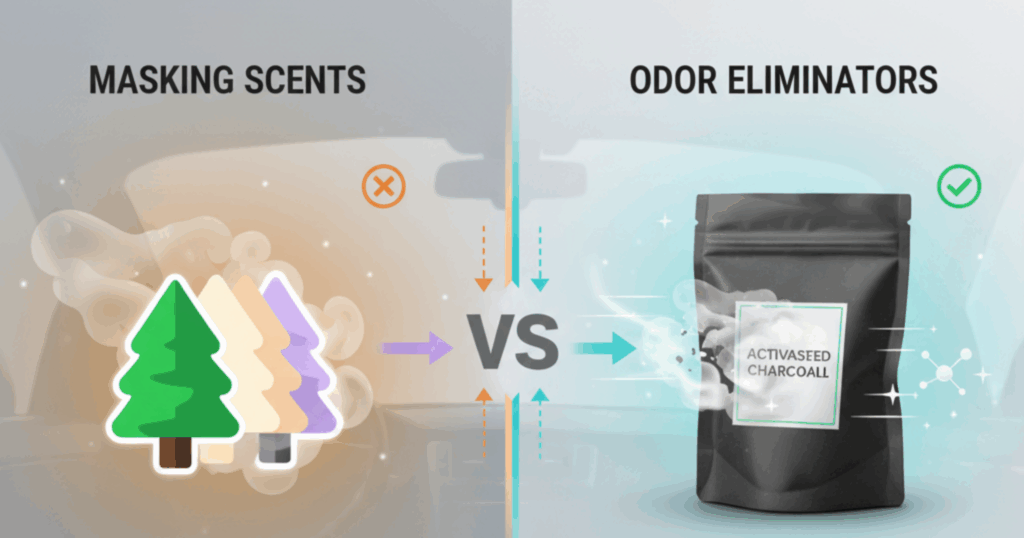
Masking Scents vs. Odor Eliminators: The Critical Difference
This is the most important section of this entire article because understanding this distinction will save you thousands of rupees and countless hours of frustration.
Masking Scents (what most people buy):
- Work by adding strong fragrances to cover up bad smells
- Don’t actually remove or neutralize odor molecules
- Create a temporary improvement that fades within hours or days
- Often result in combined smells (smoke + artificial fragrance) that smell worse than smoke alone
- Require constant reapplication and replacement
- Get progressively less effective as your nose adjusts to the masking scent
Odor Eliminators (what actually works):
- Work by chemically neutralizing odor molecules
- Actually, break down or bind with the compounds, causing bad smells
- Provide permanent or long-lasting improvement
- Don’t add artificial fragrances (or add minimal, neutral scents)
- May take longer to work initially, but provides sustained results
- Become more effective over time as they progressively reduce odor sources
Think of it this way: masking scents are like turning up your car stereo to drown out engine noise. The noise is still there—you can’t hear it as well. Odor eliminators are like fixing the engine problem—they address the root cause. For smokers’ cars specifically, masking scents are almost completely ineffective because cigarette odor is so powerful and persistent. You’d need masking scents so strong they’d be unpleasant to breathe, and even then, the smoke smell would break through within hours.
Oxidation: Some eliminators use oxidizing compounds that chemically react with smoke molecules, breaking them down into odorless compounds. This is permanent removal.
Encapsulation: Others work by encapsulating odor molecules to prevent them from reaching your nose. The source of the smell is still there but rendered undetectable.
Enzymatic Breakdown: Certain products use enzymes that biologically break down organic components of smoke odor over time.
Molecular Binding: Some eliminators contain molecules that specifically bind with smoke compounds, neutralizing their ability to produce odor.
When you use a proper odor eliminator in a smoker’s car, you’re not covering anything up—you’re actually removing the problem at a chemical level. This is why these products cost more but ultimately save money by actually solving the issue rather than requiring constant reapplication.
The Best Products for Smoker’s Cars: What Actually Works
Based on real-world testing, customer feedback, and an understanding of the chemistry involved, here are the product categories that actually eliminate smoke odor from cars rather than just temporarily masking it.
Professional Odor Elimination Sprays
These are your heavy artillery for removing the smell. Unlike consumer-grade air fresheners, professional odor eliminators are formulated specifically to neutralize stubborn odors at a molecular level.
Products like those in our odour eliminators category at Autostore.pk are designed for situations exactly like smokers’ cars. They contain chemical compounds that react with and neutralize smoke molecules rather than just covering them.
Application method matters enormously with these products. You can’t just spray them in the air and expect miracles. Here’s the proper technique:
For Fabric Surfaces (seats, carpets, headliner): Spray directly onto the fabric until it’s damp, not soaked. Work the product into the fabric with a clean brush or cloth. Allow it to dry completely—this can take several hours. As it dries, it’s actively breaking down odor molecules trapped in the fabric. Don’t use the car or turn on the AC during drying time.
For Air Vents and HVAC System: Some professional eliminators can be sprayed directly into air vents with the system running in recirculate mode. This treats the entire HVAC system from the inside. Run the system for 10-15 minutes with windows closed, then ventilate thoroughly.
The key is thorough application. Missing areas mean leaving odor sources that will continue contaminating the entire interior. This is a weekend project, not a quick fix at the petrol pump.
Activated Charcoal and Carbon-Based Absorbers
These work on a completely different principle than sprays—they physically absorb odor molecules from the air over time through a process called adsorption (not absorption—different thing).
Activated charcoal products have millions of microscopic pores that trap odor molecules. Once trapped, those molecules can’t escape back into the air. This provides continuous odor reduction as long as the charcoal remains active.
For smokers’ cars, activated charcoal bags or containers are excellent as ongoing maintenance after initial deep cleaning. Place multiple bags around the car—under seats, in door pockets and in the trunk area. They work silently and continuously without any fragrance.
Enzymatic Cleaners for Deep Fabric Treatment
For seats, carpets, and headliners that have absorbed smoke for months or years, surface spraying alone isn’t enough. You need deep penetration with enzymatic cleaners that actually break down the organic compounds in cigarette smoke.
Products in our fabric cleaners section include enzymatic formulations that work at a biological level. They contain proteins that catalyze the breakdown of complex organic molecules—exactly what you need for embedded smoke odor.
This process may need to be repeated 2-3 times for heavily contaminated interiors, but each treatment progressively reduces the embedded odor load. You’re literally digesting the smoke molecules biologically.
HVAC System Treatment Products
Specialized HVAC treatment products are sprayed into the air intake (usually near the windshield wipers) while the system is running. They coat the interior surfaces of the ducts, evaporator, and blower with odor-neutralizing compounds.
This treatment should be done twice—once early in the deodorizing process, then again after other cleaning is complete. The first treatment neutralizes existing odor, the second provides lasting protection.
Ozone Generators: The Nuclear Option
For cars with extreme smoke contamination—think someone who’s chain-smoked in a car daily for five years—ozone treatment may be necessary. This isn’t a consumer product you buy and use yourself; it requires professional equipment and safety precautions.
Ozone (O3) is an unstable molecule that aggressively oxidizes organic compounds, including all the chemicals in cigarette smoke. An ozone generator running in a closed car for several hours will oxidize and break down smoke molecules throughout the entire interior.
For most smokers’ cars, ozone isn’t necessary if you use proper products and techniques described above. But for extreme cases, it’s the only thing that works.
The Products That Don’t Work (And Why People Keep Buying Them)
Let me save you money and disappointment by explaining which popular products are basically useless for smokers’ cars, despite what the marketing claims.
Hanging Air Fresheners
You know the ones—little trees, footballs, or whatever shape, hanging from your rearview mirror. These are pure masking scents with no odor-elimination capability. The fragrance oil evaporates over days or weeks, temporarily giving your car a perfume smell.
For smokers’ cars, these accomplish literally nothing except making your car smell like cigarettes plus artificial pine/vanilla/cherry. Within hours, the smell of smoke dominates again.
Why do people keep buying them? Because they’re cheap (50-150 rupees), available everywhere (every petrol pump stocks them), and seem like they should work. The marketing shows fresh, pleasant smells, so people assume they’ll remove bad smells. They don’t.
Dashboard Gel Containers
They’re slightly more effective than hanging fresheners simply because they contain more fragrance material and last longer. But “slightly more effective at doing nothing” isn’t really a win.
In hot Pakistani weather, dashboard gels can melt, creating a sticky mess on your dashboard. I’ve seen these things literally liquify in summer heat, leaving stains on dashboards that require interior cleaners to remove.
Aerosol Spray Air Fresheners
These are a step up from hanging fresheners—they do temporarily add quite a bit of fragrance to your car’s air. Spray them, and for 20-30 minutes, your car will smell like whatever scent you chose rather than smoke.
But that’s all they do. They add fragrance oil particles into the air, which settle on surfaces over time. They don’t react with or remove smoke molecules in any way. An hour after spraying, the smell of smoke is back.
Some aerosol products claim to be “odor eliminators,” but check the ingredients—if it’s primarily fragrance oil with propellant, it’s just a masking scent regardless of what the marketing says.
Vent Clip Air Fresheners
These clip onto your air vents and release fragrance when air blows through them—slightly clever design, but the same fundamental problem: asking only, not eliminating.
They do provide continuous fragrance dispersal when the AC/heater runs, which is why they seem to work better than hanging fresheners. But they’re still just temporarily masking the smell of smoke rather than removing it.
For the 500-800 rupees these typically cost, you’d be much better off putting that money toward actual odor elimination products that solve the problem.
“Natural” Options That Don’t Work
Coffee beans in a bowl, baking soda in a container, apple slices, cotton balls with vanilla extract—Pinterest and YouTube are full of “natural odor removal” suggestions that supposedly work miracles.
I’m all for natural solutions when they work, but cigarette smoke requires actual chemistry to eliminate—you need oxidizers, enzymes, or molecular binding agents. Coffee beans aren’t going to cut it.
Creating a Complete Smoke Odor Elimination System
Here’s the step-by-step system that actually works for removing smoke smell from cars, based on combining the right products in the right sequence.
Phase 1: Initial Deep Cleaning (Day 1)
Start with the physical removal of smoke contamination. This means:
- Remove all personal items, trash, and loose objects from the car
- Thoroughly vacuum everything—seats, carpets, floor mats, under seats, trunk, door pockets, crevices around console
- Remove and wash or replace floor mats—fabric mats probably need replacing if heavily smoke-saturated
- Wipe down all hard surfaces with interior cleaners designed to cut through smoke film
- Clean windows thoroughly inside—smoke film on windows is a major odor source
This physical cleaning removes the bulk of ash, tar film, and loose smoke particles. You’re creating a clean foundation for odor elimination products to work effectively.
Phase 2: Fabric Deep Treatment (Days 2-3)
Now treat all fabric surfaces with enzymatic or chemical odor eliminators:
- Apply fabric cleaner or odor eliminator to all seats, carpets, and headliner
- Work it in with a brush, really scrubbing to get deep penetration
- If possible, use an extractor or wet/dry vac to pull out contaminated moisture
- Allow complete drying—park in the sun with windows cracked if possible
- Repeat the process if the smell persists after drying
This phase removes the massive odor load trapped in fabric fibers. It takes time, but it makes the biggest difference.
Phase 3: HVAC System Treatment (Day 4)
While fabrics are drying from Phase 2, treat the air conditioning system:
- Replace the cabin air filter if not done in Phase 1
- Spray the HVAC treatment product into the fresh air intake while the system is running on recirculate
- Run the system at full blast for 15 minutes with the windows closed
- Turn off the system and ventilate thoroughly
- Let the car sit overnight with the windows slightly open
This neutralizes odor sources inside the air conditioning ducts and evaporator that you can’t physically access.
Phase 4: Ongoing Maintenance (Ongoing)
Once initial cleaning is complete, maintain freshness with:
- Multiple activated charcoal bags are placed around the interior
- Weekly light application of odor elimination spray to fabrics
- Monthly HVAC filter checks and cleaning
- Immediate cleaning of any new ash or smoke residue
This prevents odor from building up again, even if smoking continues in the vehicle.
Phase 5: Professional Help if Needed
If, after completing Phases 1-4, the smell persists strongly, consider:
- Professional interior detailing with steam cleaning
- Ozone treatment from a qualified detailer
- Possible headliner replacement if too saturated with smoke
Some cars are so heavily contaminated that DIY methods, while significantly improving things, can’t achieve complete odor removal. Professional help isn’t admitting defeat—it’s recognizing when specialized equipment is needed.
The Pakistani Context: Unique Challenges and Solutions
Smoke odor removal in Pakistan involves some unique considerations compared to other countries.
Climate Factors
Our heat accelerates everything—both odor persistence and evaporation of cleaning products. Summer temperatures inside parked cars can exceed 60°C, which actually helps with drying after cleaning, but also bakes the smoke odor deeper into materials over time.
The solution is to time your cleaning for the cooler months if possible, or at least do it in shaded areas during summer. Early morning or evening work prevents cleaning products from evaporating before they can work.
Product Availability
Not all odor elimination products available internationally are readily available in Pakistan. That’s why Autostore.pk focuses on stocking products that actually work in Pakistani conditions and are accessible to customers nationwide.
Rather than searching for obscure specialty products, use what’s available locally from our odour eliminators and interior car care categories. These are specifically selected for effectiveness and suitability for the Pakistani climate and conditions.
Cultural Considerations
In Pakistan, smoking in cars is extremely common, especially during long drives or in traffic. Many drivers smoke with their windows closed because they think the outside air is worse than the smoke inside—or so they think.
This makes smoke odor prevention difficult, but elimination is even more important. If you’re a smoker who won’t quit or can’t smoke outside the car, using odor-removal products isn’t optional—it’s necessary for resale value and passenger comfort.
Resale Value Impact
A car that smells strongly of cigarettes loses 100,000-300,000 rupees in resale value in Pakistan’s market. Buyers will immediately offer less or walk away entirely when they smell smoke. Properly eliminating odor before selling can literally add lakhs to your car’s value.
This makes the 5,000-10,000-rupee investment in proper odor-elimination products one of the highest-ROI car maintenance expenses possible. You’re not spending money—you’re protecting your asset’s value.
Prevention: For Those Who Must Smoke in Cars
If you’re going to continue smoking in your car—which I’m not going to judge or lecture about—here’s how to minimize long-term odor buildup.
Smoke with Windows Open: Yes, dust and noise come in, but smoke actually exits rather than settling throughout your interior. Even cracking windows 2-3 inches makes an enormous difference.
Use Ashtrays: Sounds obvious, but many people ash out windows or in cup holders, spreading ash particles everywhere. A proper enclosed ashtray contains ash and can be emptied regularly.
Immediate Surface Cleaning: Once weekly, wipe down all hard surfaces with interior cleaning wipes to remove smoke film before it builds up. Five minutes weekly prevents hours of deep cleaning later.
Cabin Air Filter Replacement: Replace your cabin air filter every 3-4 months rather than the usual 6-12 months. This filter is your primary defense against smoke contaminating your HVAC system.
Activated Charcoal Maintenance: Keep high-quality activated charcoal products in the car at all times. They provide ongoing molecular-level odor absorption that prevents buildup.
These prevention methods won’t eliminate smoke odor—that’s unrealistic if you’re regularly smoking in the car—but they dramatically reduce its severity and make periodic deep cleaning much more effective.
FAQs: Car Perfumes for Smokers
Q: I’ve tried multiple odor-eliminator products from different stores, and none worked. How do I know the ones from Autostore.pk will be any different? Should I accept that the smell of smoke is permanent?
I hear your frustration because this is incredibly common—people try product after product, nothing works, and they conclude that the smoke odor is just impossible to remove. But here’s the thing: most products sold in local shops as “odor eliminators” aren’t actually eliminators at all. They’re masking scents with misleading labels. Even products genuinely formulated as eliminators fail if the application technique is wrong. The products we stock at Autostore.pk are specifically selected from professional brands like Chemical Guys, Turtle Wax, and others that use actual odor-neutralizing chemistry, not just fragrance. But equally important is HOW you use them.
Q: My husband smokes in our 2018 Cultus daily. I don’t want to nag him about it, but I’m worried about our kids breathing secondhand smoke when we use the car. If I regularly use odor eliminators, does that also eliminate the health risk, or just the smell? Should I be doing something different to protect my children?
This is such an important question because smell and health risk are related but not identical. Odor eliminators that chemically neutralize smoke molecules do reduce exposure to harmful compounds—if you eliminate the molecules causing the odor, you’re also eliminating many of the harmful chemicals. However, odor elimination doesn’t eliminate health risks from active smoking in the vehicle. When your husband smokes, fresh smoke is entering the air and your children’s lungs, regardless of how well you’ve cleaned the residual odor. The most important protection for your children is preventing smoking when they’re in the car—this is non-negotiable for their health.
Q: I bought a used 2017 Civic that smells like the previous owner smoked cigarettes. The smell is so bad that I’m considering selling it despite loving everything else about the car. Is there any realistic hope of completely removing years of accumulated smoke smell, or should I accept this mistake and sell it? How much would professional treatment cost, and is it worth it?
Don’t sell the car yet—severe smoke odor can be removed, even in heavily contaminated vehicles. Since you love everything else about the car, investing in proper treatment makes much more sense than taking the loss you’d face selling a smoke-smelling vehicle. Here’s the reality: what you’re describing probably requires professional intervention combined with DIY maintenance. A complete professional treatment, including interior steam cleaning, enzymatic treatment, HVAC system cleaning, and ozone session, typically costs 15,000-30,000 rupees,s depending on the city and detailer.
Final Thoughts: Choosing the Right Path
If you’ve read this far, you understand the fundamental truth: masking scents don’t eliminate smoke odor from cars. They’re temporary, ineffective, and ultimately waste money while the real problem gets worse.
Proper odor elimination requires understanding what’s actually causing the smell, using products that chemically neutralize odor molecules, thoroughly treating all affected areas, and maintaining freshness with ongoing care.
For smokers’ cars in Pakistan, this isn’t an optional luxury—it’s a practical necessity for:
- Protecting your vehicle’s resale value
- Maintaining a comfortable environment for passengers (especially children)
- Professional image if you use your car for business
- Your own health and well-being, even if you’re a smoker
The products, techniques, and approaches I’ve described actually work. They’re based on chemistry, not marketing hype. They cost more upfront than petrol pump air fresheners, but they solve problems rather than temporarily masking them.