Pakistan’s car market keeps changing, and if you’re a family looking for something bigger than a sedan but not as massive as a Fortuner, the Honda BR-V sits right in that sweet spot.
It’s not the newest kid on the block anymore, but it’s still hanging around showrooms and used car lots across the country. Let’s talk about what it costs, what you actually get, and whether it makes sense for your family in 2026.
What is the Honda BR-V?
Honda launched the BR-V in Pakistan back in 2017, targeting families who needed three rows of seats without spending Fortuner money. It’s basically a stretched-out Mobilio built on a modified City platform.
Think of it as Honda’s answer to the Toyota Rush, though it never quite matched that level of popularity here.
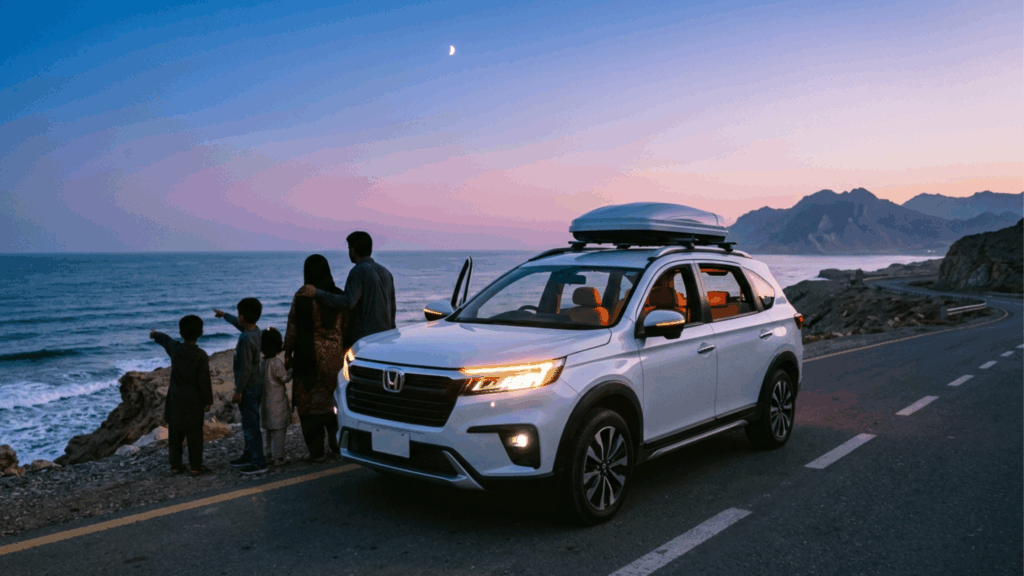
The BR-V gives you seven seats in a package that’s easier to park than a proper SUV. It sits higher than a City, which Pakistani buyers love because of our road conditions, but it’s not genuinely a rugged off-roader. It’s more of a tall wagon designed to carry your extended family on Eid visits or weekend trips to Murree.
Honda Atlas stopped local assembly of the BR-V in late 2023, so you’re now looking at either remaining stock from dealerships or the used-car market. That’s actually brought prices down a bit from the crazy peaks we saw during the import ban years.
Honda BR-V Price in Pakistan 2026
Since Honda officially discontinued the BR-V, you won’t find brand new units at authorized dealerships anymore. Whatever new stock exists is leftover inventory, and those dealers know exactly what they’ve got. Here’s what the market looks like:
Remaining New Stock (if you can find it)
Right before Honda stopped making it, the BR-V i-VTEC was priced between Rs 5,700,000 and Rs 6,200,000, give or take, depending on the variant and how much the dealer tacked on.
If a dealer still has a brand-new one gathering dust, they’ll want even more because in Pakistan, rare means expensive. You’re probably looking at Rs 6,000,000 to Rs 6,500,000, maybe higher.
At that kind of money, though, you really need to think hard about what else you could buy instead.
Used BR-V Prices 2026
This is where most buyers will end up. Used BR-V prices vary wildly based on year, condition, mileage, and how desperate the seller is. Here’s a rough breakdown:
2017-2018 Models: Rs 3,200,000 to Rs 4,000,000
These are the early models. Check them carefully for wear and tear since they’ve been on the road for 7-9 years. Mileage matters a lot here. Anything over 100,000 km should come cheaper, and you need to verify service history.
2019-2020 Models: Rs 4,200,000 to Rs 5,000,000
The sweet spot for many buyers. Old enough to have depreciated but new enough to still feel relatively modern. These models had a few running changes and improvements over the early ones.
2021-2022 Models: Rs 5,200,000 to Rs 6,000,000
Still fairly fresh. Lower mileage, likely still under some extended warranty if the original owner bought one. You’re paying a premium but getting a nearly-new vehicle.
2023 Models: Rs 5,800,000 to Rs 6,500,000
That’s the last batch Honda made. These are practically new, just registered on paper. A few might even have some factory warranty left on them. Don’t expect much of a discount from the price of new ones, though, so push back hard on the price.
Remember, these are ballpark figures. Prices in Karachi differ from those in Lahore, which differ from those in Islamabad—condition, paperwork, accident history, and the seller’s urgency all play roles.
BR-V Variants and Specifications
Unlike some markets that offer multiple engine options and trim levels, we have one main variant with minor differences over the years.
Engine and Performance
The BR-V’s got a 1.5-liter i-VTEC petrol engine under the hood. It’s basically the same engine Honda’s been using in the City and Civic for years, so reliability isn’t a concern. You get about 118 horsepower and 145 Nm of torque, which looks fine on paper. Real world, though?
Load up all seven seats with people and their bags, then try to overtake on the highway or climb a hill. The engine really struggles, and you’ll feel every bit of it.
You could get it with a 6-speed manual or a CVT automatic. Almost everyone picked the CVT because who wants to deal with a clutch in bumper-to-bumper traffic with a car full of family? The CVT works smoothly most of the time, but when you step on it for power, it just hesitates.
Fuel economy is around 12-14 km/l when driving normally in mixed conditions. Fill it up with passengers or drive aggressively and you’re down to 10 or 11 km/l. Not awful for a seven-seater, but nothing to write home about either.
Dimensions and Practicality
Length sits at 4,456 mm, width at 1,735 mm, and height at 1,666 mm. Ground clearance is 201 mm, which is better than a sedan and helps with speed breakers, but don’t think you’re taking this thing off-road.
The wheelbase measures 2,662 mm, which gives decent legroom in the first two rows. The third row is where things get tight. It’s fine for kids or short trips, but adults back there on a long drive will be uncomfortable. The third row is really an emergency option or for children.
Boot space is laughable with all three rows up. You get maybe enough room for a couple of small bags. Fold the third row down, and you’ve got usable cargo space. Fold both rear rows, and you can move furniture if needed.
Features and Equipment
Exterior Features:
- Halogen projector headlights with LED DRLs (depending on year)
- Fog lamps
- Roof rails (mostly decorative)
- 16-inch alloy wheels
Interior Features:
- Multi-function steering wheel
- Steering-mounted audio controls
- Power windows all around
- Tilt and telescopic steering adjustment
Safety Features:
- Dual airbags (front only, which is pretty basic by 2026 standards)
- ABS with EBD
- Vehicle Stability Assist
- Hill Start Assist
- ISOFIX child seat anchors
- Rear parking sensors (camera was optional or dealer-fitted)
The feature list is honestly quite basic compared to what Chinese competitors offer now. No 360 camera, no advanced driver assistance, no sunroof, no wireless charging.
It’s bare-bones functional, which kept costs down but also makes it feel dated in 2026.
BR-V Competitors and Alternatives
The BR-V faced tough competition even when it was being produced. Now that it’s discontinued, buyers have even more options. Let’s see what else you could consider in a similar price range:
Toyota Rush
The Rush is the BR-V’s closest rival, and it’s still in production. Priced higher than the BR-V, starting around Rs 6,800,000 for new units in 2026, but it has Toyota’s reputation for reliability and stronger resale value.
The Rush uses a 1.5-liter engine too, so performance is similar. It looks more SUV-like with its boxy styling, which some buyers prefer. Interior quality is comparable, maybe with slightly better fit and finish. The third row is equally cramped.
Used Rush prices hold better than BR-V prices, so you’ll pay more for a similar-year model. But that stronger resale also means you’ll lose less money when you eventually sell.
Suzuki Ertiga
If you want something new, smaller, and cheaper, the Ertiga is worth considering. It’s more of a tall wagon than an SUV, seating seven but in a smaller package. Prices start at around Rs 4,400,000 for the manual and go up to Rs 4,900,000 for the automatic.
The Ertiga uses a 1.5-liter engine with mild-hybrid technology, giving slightly better fuel economy than the BR-V. It’s also easier to drive in the city because of its smaller size. But it feels cheaper inside, and that Suzuki tinny feel is noticeable. Still, it’s new, under warranty, and significantly cheaper than a used BR-V.
Changan Alsvin / Oshan X7 (Slightly Different Segment)
If you’re flexible on the seven-seat requirement, Chinese brands offer compelling value. The Changan Alsvin sedan offers a modern car packed with features for under Rs 4,000,000. The Oshan X7 is a proper five-seat SUV with tons of tech for around Rs 7,500,000 to Rs 8,500,000.
Chinese cars pack in features Honda never dreamed of at these prices: panoramic sunroof, 360-degree cameras, adaptive cruise control and bigger screens. But reliability and resale value are question marks. Service networks are still developing, and we don’t have long-term data on how they hold up.
Used Toyota Fortuner / Honda CR-V (Step Up Option)
If you can stretch your budget to Rs 7,000,000 to Rs 9,000,000, you enter used Fortuner and CR-V territory. These are significantly better vehicles, proper SUVs with stronger engines, better build quality, and more features. A 2017-2019 Fortuner in decent condition costs around Rs 8,500,000 to Rs 10,000,000, while a similar-year CR-V runs Rs 7,000,000 to Rs 8,500,000.
Yes, it’s more expensive. But you get a genuinely capable vehicle that feels premium and holds value well. If you can afford it, it’s a massive upgrade over the BR-V.
Used Honda Civic / Toyota Corolla (Different Body Style)
If the seven-seat thing isn’t critical, a used Civic or Corolla within a similar budget makes for a much nicer daily driver. A 2020-2021 Civic or Corolla costs about the same as a used BR-V but offers better ride quality, more modern features, and superior driving dynamics.
You lose the third row and some ground clearance, but you gain refinement and efficiency. For most families, five seats are actually enough for daily use, and you can always rent something bigger for the occasional extended family trip.
Should You Buy a BR-V in 2026?
When the BR-V Makes Sense:
You Genuinely Need Seven Seats Occasionally: If you regularly carry more than five people (joint family, carpooling, weekend trips with relatives), that third row adds real value.
You Trust Honda Reliability: Honda’s reputation in Pakistan is solid—the BR-V shares components with the City, which has proven itself over the years. Maintenance costs are reasonable, parts are available, and mechanics know these engines well.
You Prefer Established Brands Over Chinese Options: Some buyers aren’t yet ready to trust Chinese brands. If you’re in that camp, your seven-seat options are basically BR-V, Rush, or Ertiga. The BR-V sits in the middle of that trio in terms of size and features.
When You Should Skip It:
Resale Value Matters to You: The BR-V has taken a hit in resale since discontinuation. It’ll keep depreciating faster than alternatives that are still in production. If you plan to sell in 3-5 years, you’ll lose more money.
You Drive Mostly Solo or With One Other Person: Why carry around seven seats of extra weight and complexity if you never use them? A sedan or five-seat crossover makes more sense for couples or small families.
You Want Strong Performance: The 1.5-liter engine moves the BR-V around fine, but it’s not exciting. Fully loaded, it feels slow. If you do a lot of highway driving or like spirited acceleration, you’ll find it frustrating.
Ownership Costs and Maintenance
Let’s talk about what it actually costs to live with a BR-V beyond the purchase price.
Fuel Costs
At current petrol prices hovering around Rs 260 per liter (prices fluctuate, obviously), and the BR-V averaging 12 km/l in real-world driving, you’re looking at roughly Rs 21.67 per kilometer in fuel costs. Drive 2,000 km a month, and that’s Rs 43,340 in fuel costs. Over a year, that’s around Rs 520,000.
Maintenance and Servicing
Honda’s service costs are reasonable compared to European brands but higher than Suzuki.
A standard service (oil change, filters, inspection) runs around Rs 8,000 to Rs 12,000 depending on whether you go to an authorized service center or a local mechanic.
Major services at 40,000 km or 80,000 km intervals cost more, ranging from Rs 25,000 to Rs 50,00,000 depending on what needs to be done.
Budget around Rs 50,000 to Rs 80,000 annually for routine maintenance if you’re driving average mileage. Add a buffer for unexpected repairs because things do break, especially as the car ages.
Spare Parts
Honda parts are generally available across Pakistan. Genuine parts from authorized dealers cost more but guarantee quality. Aftermarket alternatives are cheaper, but quality varies.
Common wear items like brake pads, filters, and bulbs are affordable. Bigger components like the CVT transmission or engine parts get expensive fast if something major fails. Extended warranties or comprehensive insurance can protect you here.
Registration and Token Tax
Annual token tax depends on the vehicle’s engine size and province. For a 1.5-liter vehicle in Punjab, you’re looking at around Rs 15,000 to Rs 20,000 annually. Karachi and Islamabad have slightly different structures but similar amounts.
Add another Rs 5,000 to Rs 10,000 for various fees, route permits if applicable, and hassle costs if you’re getting someone else to handle the paperwork.
Total Annual Ownership Cost
Rough estimate for annual BR-V ownership (driving around 20,000-25,000 km per year):
- Fuel: Rs 520,000
- Insurance: Rs 100,000 (comprehensive)
- Maintenance: Rs 65,000
- Registration and Taxes: Rs 18,000
- Miscellaneous (parking, tolls, car washes): Rs 50,000
Total: Approximately Rs 753,000 per year, or Rs 62,750 per month
That’s just ownership cost, not including the actual vehicle payment if you’re financing. If you took a car loan, add Rs 80,000 to Rs 120,000 per month to your installment, depending on the down payment and loan terms.
Buying a Used BR-V: What to Check
Since most buyers will be looking at used units, here’s a checklist of what to inspect before handing over your money.
Service History and Paperwork
Verify the service book. A BR-V with regular authorized service center stamps is worth paying extra for compared to one with no documented history. Check that all previous services were done on schedule, not just random oil changes.
Look for any outstanding finance or loans against the vehicle. Get a clearance certificate from the bank if there was previous financing.
Exterior Condition
Walk around the vehicle in good lighting. Look for mismatched paint, which indicates accident repairs. Open and close all doors, the hood, and the tailgate. Everything should align properly and close smoothly.
Check for rust, especially around wheel arches and the underbody. Pakistan’s roads and climate can accelerate rust formation.
Inspect tires. Uneven wear patterns suggest alignment issues or suspension problems. All four tires should be the same brand and relatively similar age unless the seller just replaced one or two (ask why).
Interior Condition
Wear on the driver’s seat, steering wheel, and pedals should match the claimed mileage. A car with 50,000 km on the odometer but a heavily worn driver’s seat raises red flags.
Test all features.
AC should blow cold within a minute or two. All power windows, mirrors, and seat adjustments should work smoothly. Test the infotainment system, speakers, and any other electrical features.
Mechanical Inspection
Start the engine cold if possible. It should fire up smoothly without excessive smoke or strange noises. Let it idle and listen for any knocking, ticking, or grinding sounds.
Check fluid levels. Engine oil should be at the proper level and not burnt or gritty. Coolant, brake fluid, and power steering fluid should all be at appropriate levels and clean.
Take a proper test drive, not just around the block. Get it on the highway if possible. Accelerate hard, brake hard, take corners. Listen and feel for vibrations, pulling, or unusual noises.
The CVT should shift smoothly without jerking or slipping. Under hard acceleration, it should hold the revs steady and pull without hesitation.
BR-V vs City: Should You Just Get a Sedan?
Many potential BR-V buyers should consider the Honda City instead. Here’s why:
The City costs less, both new and used. A 2020 City in good condition runs around Rs 3,500,000 to Rs 4,500,000, overlapping with the BR-V’s price range. But the City drives significantly better, feels more refined, gets better fuel economy (14-16 km/l), and has a nicer interior.
Yes, you lose the third row. But how often do you really carry seven people? Most of the time, that third row is folded down anyway, just adding weight and complexity.
The City’s boot is smaller than a BR-V with the third row folded, but it’s usable for daily needs and weekend trips. Roof racks or a small roof box meet most extra-cargo needs.
Resale value on the City is stronger. It’s still in production, more popular, and has broader market appeal. When you sell in 4-5 years, you’ll lose less money.
The only reason to pick the BR-V is if you genuinely, regularly use those extra two seats. Otherwise, the City is the smarter choice for most families.
FAQs: Honda BR-V price in Pakistan
Is the Honda BR-V still available new in Pakistan in 2026?
No, Honda Atlas pulled the plug on the BR-V back in late 2023.
Some dealers might still have a unit or two collecting dust in the back, but that’s old stock nobody wanted, not anything rolling fresh off the line. Your real options are in the used market, where you’ll pay anywhere from Rs 3,200,000 for a 2017-2018 model to Rs 6,500,000 for a barely-used 2023 in top shape.
If some dealer swears they’ve got brand-new stock, check the manufacturing date yourself and haggle as if your life depends on it. That car’s been parked there for months, probably longer, and they’re desperate to move it.
What is the fuel average of Honda BR-V in real driving conditions?
You’re looking at somewhere between 10 and 14 kilometers per liter, but that swings around a lot based on where and how you’re driving. Stuck in city traffic with constant stopping and starting?
You’ll probably see 10-11 km/l, maybe worse if you’ve got the AC cranked up in peak summer heat. Take it out on the highway and keep a steady pace without flooring it, and you can squeeze out 13 to 14 km/l fairly easily. Now pile in seven people with their luggage and watch that number drop fast.
The automatic CVT burns a bit more fuel than the manual version, but let’s be real, hardly anyone bought the manual because dealing with a clutch in Lahore or Karachi traffic is torture nobody needs.
Should I buy a used Honda BR-V or a new Suzuki Ertiga?
It really comes down to what matters more to you. The new Suzuki Ertiga sits between Rs 4,400,000 and Rs 4,900,000 with a proper warranty and zero surprises, though it feels smaller and cheaper inside with that typical Suzuki lightweight build.
A 2019-2020 BR-V in the same budget feels like a proper car with better materials, a more solid feel, and the Honda name carries more weight, but you’re gambling on someone else’s maintenance history with no warranty protection.
Final Verdict: Is the BR-V Right for You?
The 2026 Honda BR-V is a vehicle stuck in limbo. It’s not bad, but it’s not exciting either. It does one thing well (occasionally carrying seven people in a manageable package) but doesn’t excel at much else.
If you specifically need seven seats, can’t afford a Fortuner, and trust Honda over Chinese brands, a well-maintained used BR-V at the right price could work for you. Target something from 2019-2020, verify service history meticulously, get a professional inspection, and negotiate hard because the market favors buyers right now.
The BR-V made sense in its time. In 2026, with it discontinued and the market evolving, it’s become a niche choice for a very specific buyer. Make sure you’re that buyer before committing.
Keep watching Autostore.pk for updates on the latest developments in the world of Honda cars.