Most car owners in Pakistan rely entirely on mechanics for everything. A small issue crops up, and off you go to the workshop. You wait around, pay someone else, and repeat the cycle every few weeks. That’s fine if you like spending money and time on things you could easily handle yourself.
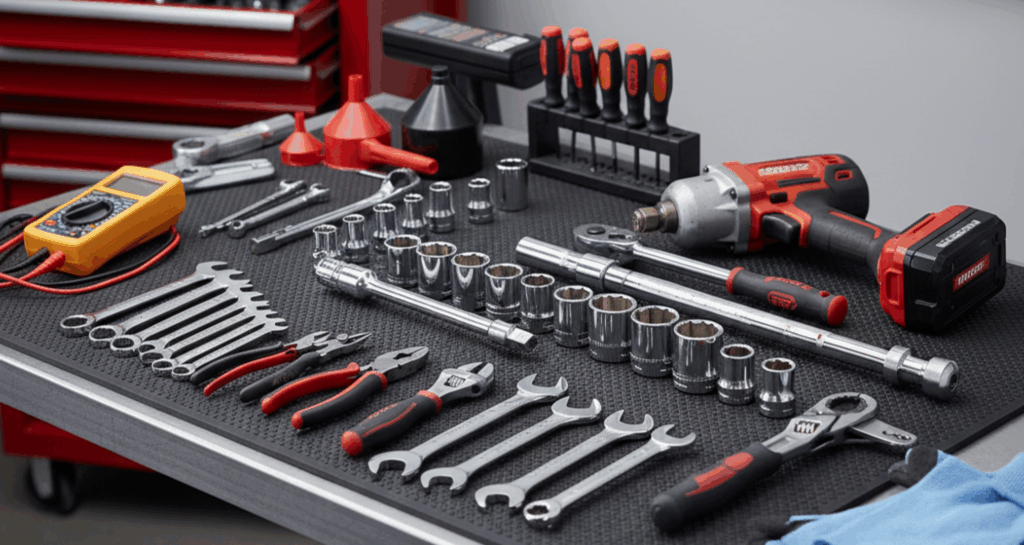
Having the right tools changes the game. You’re not trying to become a full-time mechanic. You just want to handle basic maintenance, fix minor issues, and avoid unnecessary trips to the workshop. A small collection of quality tools covers most routine tasks. You’ll save money, learn how your car actually works, and gain confidence in keeping it running properly.
This guide walks you through ten essential tools that belong in every garage. We’ll explain what each tool does, why it matters, and what to look for when buying.
The Ten Tools That Cover Most Situations
1. Socket Set with Ratchet
This isn’t optional.
A socket set does more work than anything else you’ll own. Bolts all over your car come in different sizes, and sockets let you remove and tighten them properly without destroying the heads.
What to look for:
Grab a set with both metric and imperial sizes, even though most Pakistani cars run metric. You never know when you’ll need that odd imperial size. Range should go from 8mm up to at least 24mm.
The ratchet mechanism is what makes life easier in cramped engine bays where you can’t swing a full circle with a regular wrench.
Deep sockets and drive sizes matter:
Get a set that includes deep sockets as well as standard ones. Deep sockets reach bolts that sit farther back, like spark plugs buried in the engine. You want both 1/4-inch and 3/8-inch drive sizes, too. Smaller drive handles delicate work without overtightening.
2. Combination Wrench Set
Sockets can’t reach everywhere.
Sometimes you need the flat profile of a wrench to fit into cramped spaces. A combination wrench has an open end on one side and a closed ring on the other, giving you options for different situations.
The open end lets you slide onto bolts from the side when there’s no room to fit a socket from above. The closed-ring end grips all six sides of a bolt head, reducing the risk of slippage and stripping.
Like your socket set, get a range of metric sizes. Start from 8mm and go up to at least 19mm. The most commonly used sizes for cars are 10mm, 12mm, 13mm, 14mm, and 17mm. These cover everything from battery terminals to wheel nuts.
3. Screwdriver Set
You’d be surprised how many things on a car are held together with screws. Interior trim panels, battery hold-downs, air filter housings, and dozens of other components all use screws instead of bolts.
Get a set of screwdrivers with multiple sizes of both flathead and Phillips-head screwdrivers. You’ll use Phillips more often, but flathead still shows up on older vehicles and certain types of clips. Magnetic tips help when you’re trying to start a screw in a difficult spot or when you drop one into a tight space.
What makes a good screwdriver:
Decent screwdrivers have grips that stay put even when your hands are covered in oil and grime. The tips need to be hardened steel that keeps its shape after repeated use. Cheap ones wear down fast, round off screw heads, and turn a five-minute job into an hour of frustration.
4. Jack and Jack Stands
That scissor jack sitting in your boot? Only use it for roadside emergencies. It’s painfully slow, wobbles like crazy, and puts you at serious risk if you’re doing actual work. A proper floor jack lifts your car smoothly and keeps things stable while you’re underneath.
Choosing the Right Jack Capacity
For everyday sedans, hatchbacks, and compact cars, a good 2-ton hydraulic floor jack is more than capable of handling tasks like changing wheels, checking brakes, or getting under the car for a quick inspection.
If you own a heavier SUV—something along the lines of a Prado, Fortuner, or a similarly sized vehicle—it is worth upgrading to a 3-ton jack. The extra lifting capacity gives you a better safety margin, makes the job feel less strained, and gives you more confidence every time you lift your car.
The Rule That Is Never Optional
Never get underneath a car supported only by a jack. A jack is meant to lift the vehicle—not hold it safely in the air while you work beneath it. It can slip, lose pressure, or shift if the car moves unexpectedly.
Lift the car using the correct factory jacking point, then place properly rated jack stands beneath the approved support points or frame areas. Slowly lower the vehicle onto the stands and make sure it feels stable before going anywhere near the underside.
Picking Good Jack Stands
Always use jack stands rated comfortably above the weight they will carry, and use them as a matching pair on firm, level ground. A wide, solid base makes a big difference, especially on concrete or uneven surfaces where cheaper stands can feel unstable. You also want a strong locking system that stays firmly in place once the car is resting on it.
Ratchet-style and pin-style stands can both do the job well if they are properly rated, in good condition, and used correctly. The important part is not just buying decent stands—it is placing them under the correct support points, lowering the car onto them carefully, and giving the vehicle a firm shake before you start working underneath. If it does not feel completely solid, stop and reset it. When you are under a car, there is no such thing as being too careful.
5. Tire Pressure Gauge and Air Compressor
Proper tire pressure matters more than most people realize. Underinflated tires wear out faster, reduce fuel economy, and make your car handle poorly. Overinflated tires ride rough and are more prone to damage from potholes.
A simple analog or digital tire pressure gauge costs very little and takes seconds to use. Check your tires when they’re cold, before you’ve driven anywhere. The correct pressure is listed on a sticker inside your driver’s door jamb, not on the tire sidewall. That number on the tire is the maximum pressure, not the recommended pressure.
A portable air compressor saves you trips to the petrol pump. The 12V models that plug into your cigarette lighter work fine for topping off tires. For faster inflation or running air tools, get a larger compressor that plugs into AC power.
AutoStore.pk carries both portable compressors from brands like Kenco and Ingco, plus more powerful workshop models. Having your own compressor means you can adjust pressure anytime, not just when you’re near a pump that actually works.
6. Pliers Set
Pliers grip things that wrenches and sockets can’t handle. Hoses, clips, electrical connectors, and various other parts all require pliers at some point during maintenance or repairs.
At minimum, get three types. Slip-joint pliers adjust to different widths and handle general gripping tasks. Needle-nose pliers reach into tight spots and hold small parts. Locking pliers clamp onto rounded or stripped bolt heads when nothing else will grip them.
Wire cutters and strippers come in handy for any electrical work. If you ever install accessories like LED lights, cameras, or audio equipment, you’ll need to cut and strip wires cleanly.
7. Oil Filter Wrench
Changing your own engine oil is one of the easiest maintenance tasks you can learn. It saves money and ensures the job gets done right with quality oil. The only tricky part is removing the old oil filter, which gets tightened down and stuck in place.
Oil filter wrenches come in several styles. The band-type wraps around the filter and tightens as you turn it. The cap-style fits over the end of the filter and works with your ratchet. The claw-style has three adjustable legs that grip the filter body.
For most cars, the adjustable band-type works well and fits filters of different sizes. Make sure you get one that opens wide enough for your specific filter. Some trucks and SUVs use larger filters that need a bigger wrench.
Pair this with an oil drain pan to catch the old oil cleanly. AutoStore.pk stocks both the wrenches and drain pans you need for complete oil changes at home. Quality engine oils from Liqui Moly, Kixx, and Mobil are also available so you’re not compromising on what goes into your engine.
8. Torque Wrench
A torque wrench takes the guesswork out of tightening bolts.
Every vehicle has its own torque setting, so always check the owner’s manual or workshop specifications rather than assuming one number works for every car.
Overtightening can damage wheel studs, stretch threads, or even contribute to brake rotor issues. Leave the nuts too loose, though, and the wheel can shift or, in a worst-case situation, come off while driving.
Over-tighten and you risk warping brake rotors or snapping studs. Under-tighten and your wheel could come loose on the highway, which is terrifying to even think about.
This ensures even clamping force and prevents warped brake rotors.
Get a click-type torque wrench in the 20-150 Newton-meter range for general automotive use. When you reach the set torque, the wrench clicks and releases slightly so you know to stop. This prevents overtightening, even when you’re applying a lot of force to the handle.
Store torque wrenches at their lowest setting when not in use. This prevents the internal spring from staying compressed, which would reduce accuracy over time. Treat it carefully since dropping or using it as a breaker bar can throw off the calibration.
9. Multimeter
Electrical issues drive even seasoned mechanics crazy, but a multimeter takes the guesswork out.
It reads voltage, current, and resistance, so you can pinpoint problems with your battery, alternator, sensors, and wiring instead of randomly replacing parts and hoping something works.
You don’t need an expensive professional unit. A basic digital multimeter handles all common automotive testing. Look for one with an easy-to-read display and clearly labeled function settings.
The most common use is checking battery voltage. A healthy 12-volt battery should read around 12.6 volts when the car is off. While running, you should see 13.8 to 14.4 volts if the alternator is charging properly. Lower readings mean your battery is dying, or your alternator isn’t working.
You can also test fuses, check for wiring shorts, and diagnose sensor problems. When your check engine light comes on, checking sensor voltages helps narrow down the cause before you waste money replacing parts that aren’t actually faulty.
10. Basic Tool Organizer
It may not be a tool in the usual sense, but proper tool storage is just as important as the tools themselves. When sockets, spanners, and screwdrivers are spread across the garage floor, even a simple job takes longer than it should. And somehow, the one tool you need always disappears when you are halfway through the work.
A good toolbox, cabinet, or storage trolley keeps everything in its place, easy to reach, and protected from dust, moisture, damage, or getting lost. If you have spent money building a decent collection of tools, keeping them organised is part of looking after them properly.
Storage options that actually work:
- A rolling tool chest works brilliantly if you have floor space to spare.
- Multiple drawers mean you can sort everything logically, and you can roll it to wherever you’re working instead of running back and forth.
- Wall-mounted panels save space in tighter garages. Hooks and holders let you see every tool at a glance and grab what you need instantly.
- A sturdy toolbox is your minimum starting point. Keeps your go-to items together in one place, and you can carry it around to different work spots without hassle.
The Long-Term Value of Building Your Garage
The initial investment in quality tools feels significant.
A complete starter set with everything on this list might run you 30,000 to 50,000 rupees depending on brands and quality levels. That seems like a lot until you calculate what you save.
One oil change at a workshop costs between 3,000 and 5,000 rupees, depending on your vehicle and the oil used. Do it yourself, and quality oil plus a filter from AutoStore.pk costs half that. After ten oil changes, you’ve already recouped your tool investment.
Add other maintenance tasks, such as air filter changes, spark plug replacements, wiper blade swaps, and various small repairs. Each one costs significantly more at a workshop than handling it yourself. Within a year or two of regular DIY maintenance, your tool collection has paid for itself several times over.
Beyond the financial savings, you gain independence. Car problems don’t leave you stranded or stressed about workshop availability. You handle issues on your schedule, confident in the quality of your work because you’re doing it yourself.
FAQs: Car Tools
1. What’s the minimum I need to spend on a basic car tool set in Pakistan?
Plan on spending 15,000 to 20,000 rupees for a starter tools kit that won’t fail you halfway through a job. That gets you a basic socket set, combination wrenches in standard sizes, some screwdrivers, a proper floor jack, and jack stands for safe working.
Skip the shiny chrome-plated tools with fancy leather cases. Go with dependable mid-range brands like Ingco that hold up under real use when you’re dealing with stuck bolts.
2. Can I safely work under my car with just a jack, or do I really need jack stands?
Never work under a vehicle supported only by a jack. Jacks can fail mechanically, slip off their lift point, or settle unevenly on soft ground.
Every year people get killed or seriously injured when jacks collapse while they’re underneath. Jack stands provide redundant support that catches the vehicle if anything goes wrong with the jack. Use your jack to lift the car, position jack stands under solid frame points, then lower the car onto the stands before crawling underneath. This takes an extra minute but eliminates the risk of being crushed.
Quality jack stands from AutoStore.pk cost a few thousand rupees, which is nothing compared to the safety they provide. Professional mechanics follow this same procedure because they understand the risks involved.
3. Which tools should I buy first if I can only afford a few items right now?
Look, if money’s tight, focus on four essentials that cover most jobs. Get a socket set with a ratchet ranging from 8mm to 19mm; it handles more bolts than anything else you’ll own.
Add a combination wrench set in the same size range for tight spots where sockets won’t fit, such as battery terminals and certain engine brackets. Grab a screwdriver set with multiple Phillips and flathead sizes since interior panels, air filter boxes, and trim pieces all use screws constantly.
Finally, invest in a proper floor jack and jack stands because the scissor jack in your boot is useless for real work, and jack stands keep you from getting crushed if something fails.
Starting Small and Expanding Over Time
You don’t need to buy everything at once. Start with the most essential items and add tools as your needs and skills develop.
Watch for situations where you need to borrow a tool or visit a workshop for something you could have done yourself. Those moments tell you what to add next to your collection. If you keep needing to borrow an oil filter wrench, that’s your cue to buy one.
Quality over quantity matters more than having every possible tool. A complete set of good wrenches serves you better than a massive collection of cheap ones that round off bolt heads.