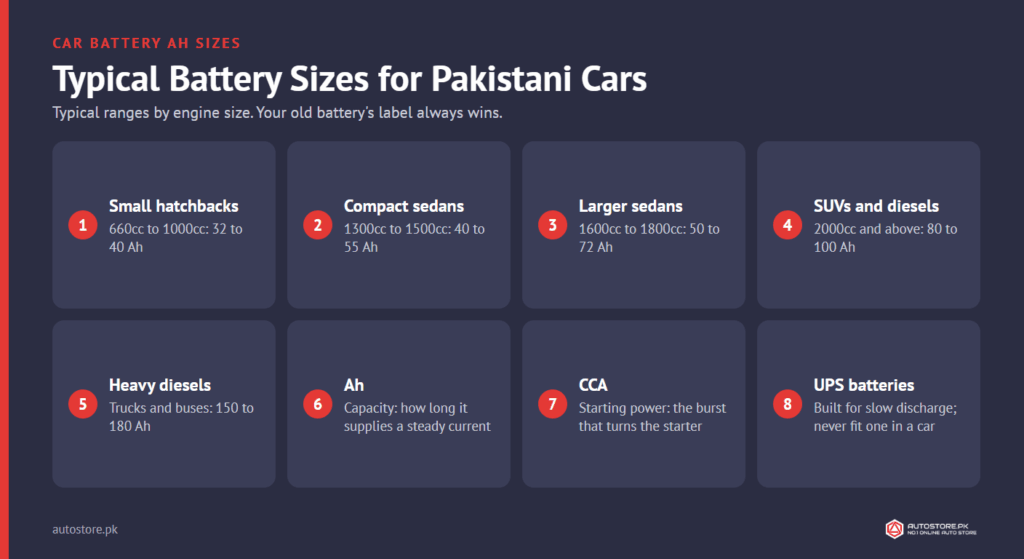
The right car battery Ah rating for most Pakistani cars is about 32 to 40 Ah for a small 660cc to 1000cc hatchback, 40 to 55 Ah for a 1300cc to 1500cc sedan, 50 to 72 Ah for a 1600cc to 1800cc car, and 80 to 100 Ah for large SUVs and diesels. All of these are 12-volt batteries. The label on your old battery and your owner’s manual decide the exact size.
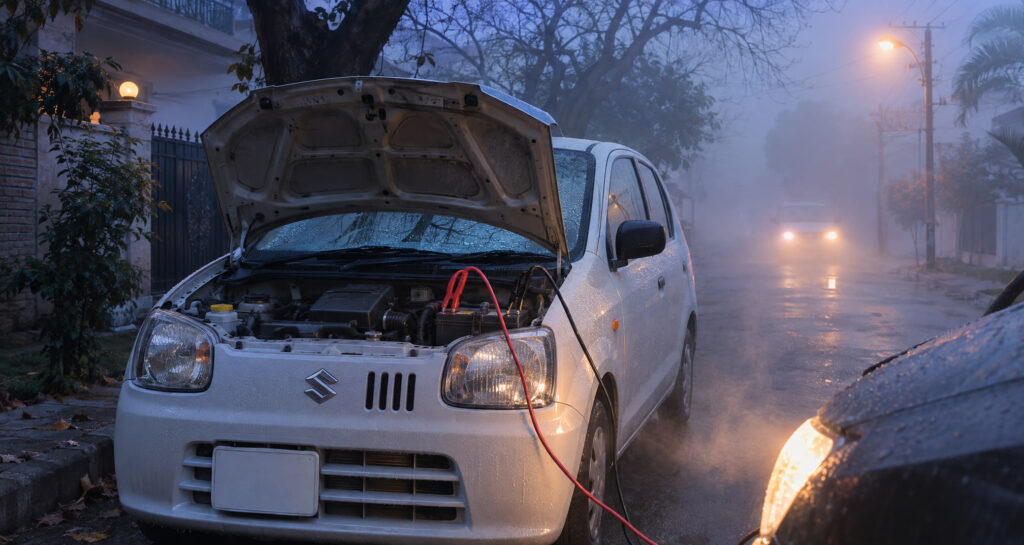
Car batteries give up in November. A battery that was weak in October still starts a warm engine. Then the first cold morning in Lahore, Islamabad or Murree arrives, you turn the key, and all you get is a click. Read on for what a car battery Ah rating means and why cranking amps matter more in winter. After that come the cost of the wrong size and a test you can run before the battery strands you outside the office.
Which Battery Ah Rating Does Your Car Need?
Start with the battery your car came with. Its label carries the car battery Ah rating, the cold cranking amp (CCA) rating and the terminal layout. Then match all of them. If the old label has faded, use the table below. The ranges come from a battery maker’s application list for Pakistani cars and from the sizes on sale in the local market. Treat it as a starting point, then confirm with your manual or a battery shop.
| Vehicle type | Typical engine | Typical Ah range | Example listed for these cars |
|---|---|---|---|
| Small hatchbacks (Alto, Mehran, Cultus, Wagon R) | 660cc to 1000cc | 32 to 40 Ah | NS46L, 34 Ah, listed for Suzuki cars and vans |
| Compact sedans (City, Yaris, older Civic) | 1300cc to 1500cc | 40 to 55 Ah | NS55ZL, 40 Ah (Toyota, Honda); NS65, 55 Ah (Civic) |
| Larger sedans (Corolla, Civic 1.8) | 1600cc to 1800cc | 50 to 72 Ah | N80, 65 Ah and NS90, 72 Ah, both listed for Corolla |
| Large petrol cars, SUVs and diesels | 2000cc and above | 80 to 100 Ah | N100Z, 80 Ah (Mercedes-Benz petrol) |
| Trucks, buses and big commercial diesels | Heavy diesel | 150 to 180 Ah | Commercial range; ask the dealer |
Two cautions. First, the maker’s application list behind these examples dates from 2016, and newer models may ship with a different battery, so the label in your engine bay wins. Second, hybrids such as the Aqua, Prius and Corolla Cross hybrid use a separate 12-volt auxiliary battery, and the maker sets its size and type. Ask for that exact part. Our guide to extending hybrid battery life in Pakistani heat covers the big hybrid battery itself.
What the Car Battery Ah Rating Measures and What CCA Measures
Walk into any battery shop on McLeod Road and you will be asked one question: how many amps? However, the car battery Ah rating is only half the story.
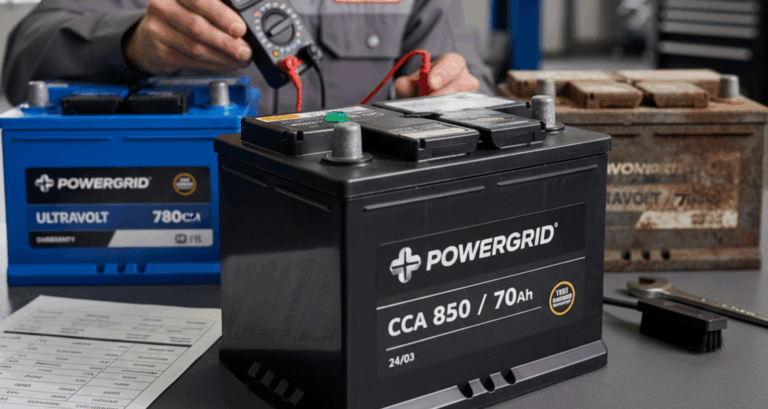
- Ah (ampere-hours) is capacity. It tells you how much energy the battery stores and how long it can supply a steady, small current. So a higher Ah battery runs the lights, radio or dashcam for longer with the engine off.
- CCA (cold cranking amps) is starting power. It is the short, heavy burst that turns the starter motor. Under the SAE J537 test, a battery rated at 500 CCA must deliver 500 amps at minus 18°C for 30 seconds without its voltage dropping below 7.2 volts.
An engine starts on a burst of current that lasts a few seconds, and in winter that burst fails first. Two batteries with the same Ah rating can also have quite different CCA ratings, because CCA depends on plate design as well as size. So once you have the right physical size, check that the CCA figure at least matches your old battery. If the seller cannot tell you the CCA, ask to see it on the label.
Why 100 Amp Batteries Come Up So Often
“100 amp battery price” gets searched more than any other size in Pakistan, because 100 Ah is the common size for home UPS systems as well as big diesel SUVs. Load-shedding made everyone a battery buyer. A 100 Ah UPS battery gives a long, slow discharge, while a car battery gives short, heavy bursts. Keep each in its own job, and tell the shop which one you are buying for.
What Happens If the Battery Ah Rating Is Wrong for Your Car
Get the car battery Ah rating wrong in either direction and you pay for it.
Too Small
- Repeated deep discharge. A small battery drains further every time you start the car or use accessories with the engine off. Lead-acid batteries wear out faster the deeper you drain them.
- Weak winter starts. A small battery has less cranking power to begin with, and cold takes away a large share of what is left.
- Trouble with accessories. A tracker, a dashcam on parking mode, extra lights or a big sound system all draw current, some of them even when parked. A battery at the bottom of the range runs flat sooner.
Too Large
- It may not fit. A bigger case may not sit in the tray or under the clamp. A battery that moves around shakes its plates loose and can short against the bonnet.
- Terminals in the wrong place. Batteries come with the positive terminal on the left or the right. The wrong layout means stretched cables, or cables that do not reach at all.
- More cost, little gain. A larger battery costs more and weighs more. The alternator also takes longer to recharge it after a start, which matters if you only make short trips.
One step up in Ah within your car’s normal range is usually fine if the case fits and the terminals line up. Far outside the range, though, you pay more and gain nothing.
Why Car Batteries Fail in Winter
A car battery makes electricity through a chemical reaction. Cold slows that reaction and raises the battery’s internal resistance, so it cannot deliver as much current. A battery that gives 100 percent of its capacity at 27°C typically delivers about 50 percent at minus 18°C, as this guide to battery performance in heat and cold shows. The plains rarely get that cold. Even so, the loss starts well above freezing, and in Murree, Swat, Gilgit and the north, nights do drop below zero.
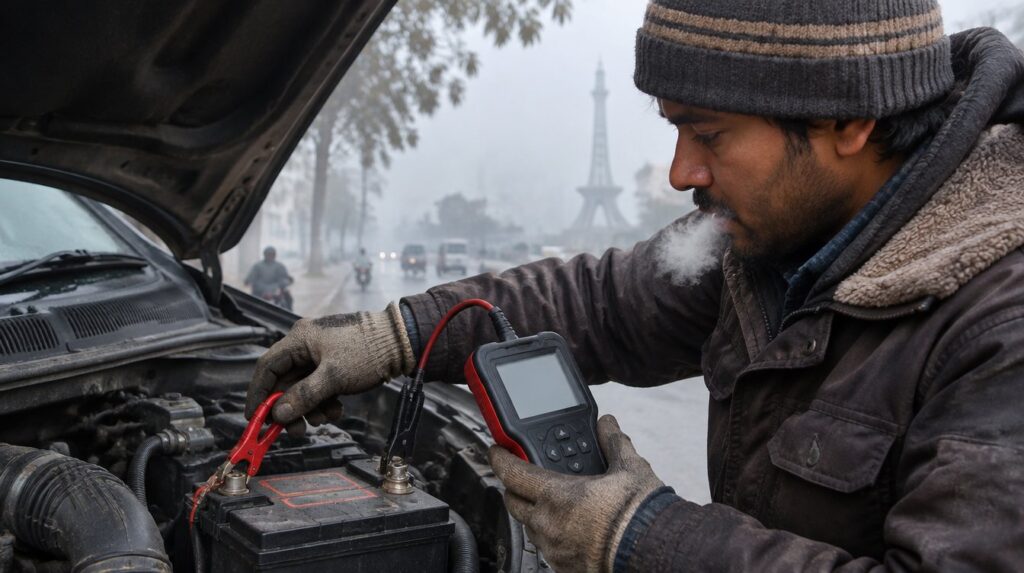
At the same time, the engine needs more power to turn over. Engine oil thickens in the cold, so the starter has to work harder to spin the engine. Our guide to cold-start engine oils for Murree winters explains why oil grade matters here. So the battery has less to give at the moment the engine wants more, and a battery that was marginal in October fails in December.
Winter habits add to it. In fog and smog the headlights, fog lights, wipers, heater blower and rear demister all run at once, often on a crawl through Mall Road traffic. As a result, the alternator may not have time to put back what the start took out. If you drive in fog, read our motorway fog safety guide before your first long winter trip.
Six Signs Your Battery Is About to Die
Batteries rarely die without warning, so watch for these six signs, especially on cold mornings.
| Warning sign | What it usually means | What to do |
|---|---|---|
| Slow crank: the engine turns over slowly before it starts | The battery cannot deliver full cranking current, often worse when cold | Test the battery this week |
| Dim headlights at idle that brighten when you rev | The battery is low, or the charging system is weak | Test both the battery and the alternator |
| Clicking when you turn the key, but no crank | Not enough current to turn the starter; loose or dirty terminals can do the same | Check the terminals, then test; jump start if needed |
| Battery or charging warning light on the dashboard | A problem in the charging system or battery | Get it checked before a long drive |
| Swollen or bulging battery case | Internal damage, often from heat or overcharging | Replace the battery and check the charging system |
| White or green crust on the terminals | Corrosion that blocks current flow | Clean the terminals; replace corroded clamps |
One sign on its own may have a simple cause, such as a loose clamp. However, two or more together usually mean the battery is near the end. A swollen case needs no second sign: replace it straight away.
How to Test a Battery Before It Strands You
A cheap digital multimeter from our car tools and workshop equipment range gives you a basic check at home. For a full answer, though, get a load test at a battery shop.
Step 1: Check Resting Voltage
First, park the car and let it stand for at least four hours, ideally overnight. A lead-acid battery needs at least four hours of rest for an accurate reading, and makers recommend 24. Then measure across the two terminals with the engine off and compare with the table, which uses industry figures measured at 26°C. This explainer on measuring state of charge has the background.
| Resting voltage | Approximate state of charge |
|---|---|
| 12.65 V | 100 percent |
| 12.45 V | 75 percent |
| 12.24 V | 50 percent |
| 12.06 V | 25 percent |
| 11.89 V | Fully discharged |
Cold lowers the reading a little, and a freshly charged battery can read falsely high for a while. A battery at 50 percent or lower after a full night’s rest needs charging and testing. That holds even if you drove to Faisalabad and back the day before.
Step 2: Get a Load Test
Resting voltage tells you nothing about cranking power, so get a load test. The shop puts a heavy load on the battery for a short time and watches the voltage. In a carbon-pile test, the tester loads the battery at half its CCA rating for 15 seconds. The battery passes if the voltage stays above 9.6 volts. Many battery shops in Pakistan will run a quick test for free or for a small charge, so ask before you buy a battery you may not need. Once a starter battery’s CCA has dropped to 50 percent of its rating, replace it.
Making the Battery Last in Pakistani Conditions
- Avoid a diet of short trips. Every start takes energy out, and a five-minute run to the market does not put it back. Give the car a drive of half an hour or more at least once a week.
- Keep the terminals clean and tight. Wipe away corrosion and make sure you cannot move the clamps by hand. Replacement battery terminals and accessories cost little compared with a breakdown.
- Secure the hold-down clamp. Pakistani roads, speed breakers and potholes shake a loose battery until its plates crack.
- Watch summer heat as well as winter cold. Heat damages a battery through the summer, and winter is often when that damage finally shows.
- Turn off the extras first. Switch off the headlights, fog lights, heater blower and demister before you turn off the engine, so the next start does not have to fight them.
- Carry a backup. Keep booster cables or a portable starter from our jump starters and booster cables range in the boot, and a dead battery costs you ten minutes. Also, learn how to jump start a car safely before you need to.
The battery is one item on a longer list. Our winter car prep checklist covers the rest, and the coolant and antifreeze guide explains why the right coolant matters in cold weather too.
Buying the Right Car Battery Ah Rating in Pakistan
We leave brand rankings to our AGS vs Volta vs Osaka battery comparison. The table below lists example models at each size, so you know what to ask for once you know your car battery Ah rating.

| Size | Example listings |
|---|---|
| 30 to 40 Ah | AGS GR-46 (30 Ah), Volta CR65L+ and Phoenix XP-60L (40 Ah) |
| 45 to 50 Ah | Exide N65L, AGS GR-65 and MF-65L (45 Ah), Phoenix XP-75R (50 Ah) |
| 60 Ah | AGS GR-87 |
| 80 to 90 Ah | Osaka MF-100L and AGS HB-100R (80 Ah), Exide EX110R (85 Ah), Osaka MF110R (90 Ah) |
| 100 Ah | Volta T-125 S, Exide N135, AGS SP-145, Phoenix EXT-130; AGS SP-140 at a second retailer |
| 180 Ah | Osaka P260-S, Volta P-250 S |
These are examples from Pakistani retail listings, and what each shop carries differs by city and dealer. When you get a quote, ask whether it includes a discount for handing in your old battery, and how long the warranty runs.
Who Needs a Car Battery With a 100 Ah Rating?
A 12-volt, 100 Ah car battery makes sense for large diesels and big SUVs that came with one. In a Corolla or a City it adds cost and weight for little benefit. If the 100 Ah is for a home UPS, buy a battery built for deep discharge.
What to Ask Before You Buy
- What are the Ah and CCA ratings, and do they match or beat my old battery?
- Does the case fit my tray, and is the positive terminal on the same side?
- Check the manufacturing date. A battery that has sat on a shelf for months may need charging before fitting.
- How long is the warranty, and what does the shop need from me to claim it?
- Ask them to test your old battery first, and to take it back for a discount.
You can browse Volta batteries, AGS batteries and Osaka batteries on Autostore.pk. For current prices on these, message autostore.pk on WhatsApp.