
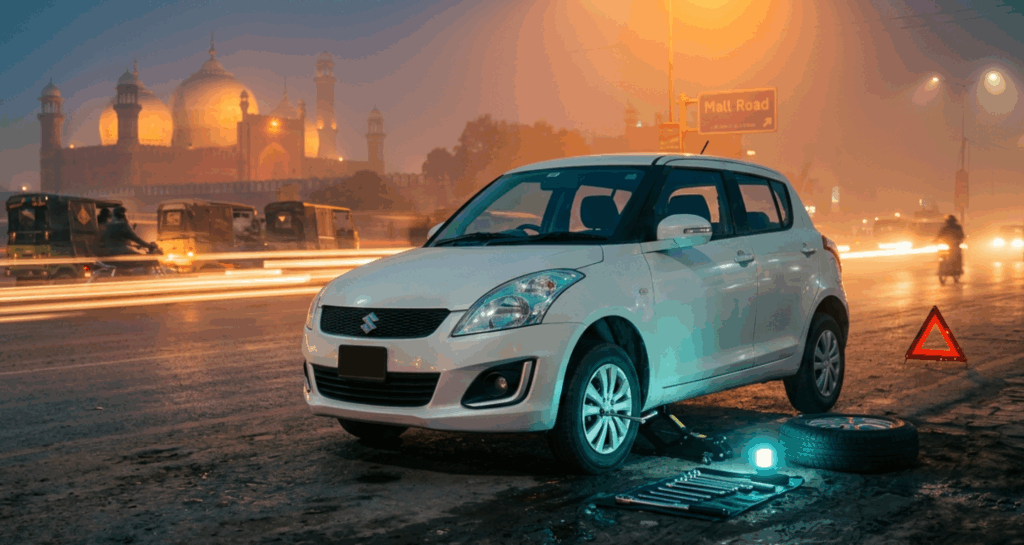
You are on Lahore Ring Road on a November evening. The smog is thick outside.
Then you hear a flapping sound. The steering pulls hard to the left.
You have a flat tire. The nearest puncture shop may be closed or far away.
This guide shows you how to change a car tire in six steps. It also covers what to keep in your trunk and what to do differently in smog.
Why Every Lahore Driver Should Know How to Change a Car Tire
Lahore roads are hard on tires. Potholes, construction sites and loose debris are part of most daily drives.
- Nails and sharp metal often sit near building sites.
- A puncture shop may not be open late at night.
- Standing on the roadside in smog season is bad for your lungs.
With practice, a tire change takes about 20 minutes, says Michelin.
Knowing the steps means you spend less time outside the car and more time on your way home.
Add wet wipes and hand sanitizer so you can clean up afterward.
Missing something? Browse the car care and tools category to fill the gaps.
How to Change a Car Tire in Six Steps
Step 1: Stop in a Safe, Level Spot
- Turn on your hazard lights as soon as you feel the flat.
- Drive slowly to firm, level ground away from traffic. Never stop in a moving lane on roads like Ferozepur Road.
- Shift into Park. In a manual car, use first gear.
- Pull the handbrake up firmly.
- Place a wheel chock against the wheel diagonally opposite the flat.
- Set the warning triangle a few meters behind the car.
- Get passengers out and away from the road.
Step 2: Loosen the Lug Nuts
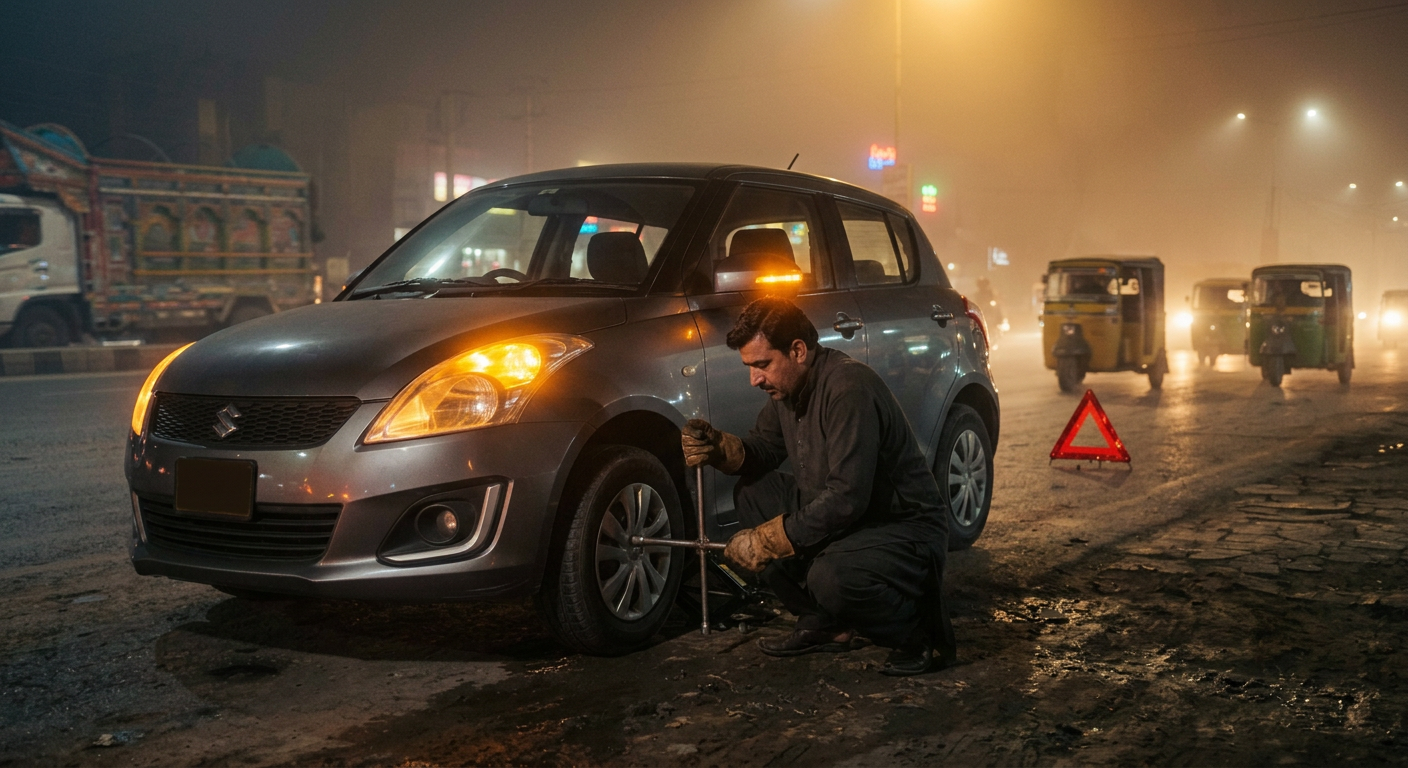
Do this before you lift the car. Once the car is lifted, the wheel will just spin when you turn the wrench.
Turn each nut counterclockwise. If one will not move, hold the wrench level and press down on the handle with your foot. Keep a hand on the car for balance.
Loosen each nut about one full turn. Do not remove them yet.
Step 3: Lift the Car With the Jack
Find the jack point in your owner’s manual. On most cars, it is the pinch weld, a reinforced metal seam behind the front wheel or in front of the rear wheel.
Putting the jack anywhere else can damage the side skirt or the floor pan.
- Place the jack squarely under the jack point.
- Lift slowly and watch that the jack stays straight.
- Stop when the flat tire is about 15 cm (6 inches) off the ground (as suggested by this The Tire Reviews).
- Never put any part of your body under the car.
Step 4: Swap the Wheel
- Remove the loosened nuts and keep them in your pocket or the upturned hubcap.
- Grip the flat tire with both hands and pull it straight toward you.
- If rust holds it in place, tap the tire firmly to break it loose.
- Lay the flat tire under the car, near the jack. It gives you a backup if the jack slips.
- Line up the holes on the spare with the wheel studs and push it fully onto the hub.
Step 5: Hand-Tighten in a Star Pattern
Thread every nut on by hand first. This prevents cross-threading.
Then snug them lightly with the wrench. Work in a star pattern: tighten one nut, then the nut directly across from it.
This seats the wheel evenly against the hub.
Step 6: Lower the Car and Tighten Fully
Lower the car until the tire rests on the ground, then remove the jack.
Tighten each nut firmly, again in a star pattern. Most passenger cars need 80 to 100 ft-lbs of torque. Your owner’s manual has the exact figure.
Do not jump on the wrench. Too much force can stretch the studs.
After a few kilometers, stop and check the nuts again. A tire shop can torque them properly.
Changing a Tire in Smog or at Night
Smog cuts visibility sharply. Other drivers may not see you until they are close.
- Keep your hazard lights on for the whole job.
- On fast roads like Ring Road, place the triangle farther back than usual.
- Stick a magnetic LED work light to the fender so both hands stay free.
- Wear an N95 mask. Physical work makes you breathe harder.
- If the shoulder is too narrow, drive slowly with your hazards on to a safer spot.
Smog does more than hurt visibility. Our guide to protecting your car’s paint in Lahore smog explains how it affects your car’s finish too.
Browse our LED lights collection for brighter options.
Full-Size Spare vs Space Saver
Many newer cars come with a space saver spare, also called a donut. It is narrower and lighter than a normal tire.
Spare Tire Showdown
Full-Size vs. Space Saver
On a space saver, stay under 80 km/h and drive straight to a tire shop.
Check your spare’s pressure every month. The correct figure is printed on its sidewall or on the placard inside the driver’s door.
Tire Inflators and Tire Care That Prevent Roadside Stops
When an Inflator Is Enough
A small nail often causes a slow leak, not a full flat. You may only need air.
- Plug a digital tire inflator into the 12V socket.
- Attach the hose to the valve stem and set the pressure.
- Digital models stop automatically at the set pressure.
- Leave the nail in place. Pulling it out makes the leak faster.
Most 12V inflators run for about 5 to 10 minutes before they need to cool down, according to The Drive.
That is usually enough to top up a tire and reach a shop.
Simple Habits That Prevent Flats
- Check your tire pressure every two weeks against the door placard.
- Underinflated tires run hot and are more likely to blow out.
- Overinflated tires wear unevenly and give a harsh ride.
- Get a tire cleaner. Read this guide on car tire cleaners and how to use them.
- Look for cracks, bulges and bald patches.
- Use a tire protectant to slow sun cracking in Lahore’s summer heat.
For more low-cost ways to protect your car, see our budget car upgrades guide.
Frequently Asked Questions
Final Word
Lahore roads will give you a flat sooner or later. Being ready makes it a 20-minute job instead of a long wait.
- Practice once at home this weekend.
- Check your spare every month.
- Build your Tool Kit so you’re ready when you need it.
Stay safe on the road this foggy season.


