Pop quiz: When was the last time you actually looked at your tire expiry date?
Not just glanced at it while loading grocery bags into your boot. Actually looked at it, checked its condition, verified it was properly inflated, and confirmed it was safe to use in an emergency.
If you’re like most Pakistani car owners, the answer is probably “never” or “I honestly can’t remember checking the tire expiry date.”
Here’s a disturbing reality that most people don’t know: tire expiry dates are real. Just like the medicine in your cabinet or the milk in your fridge, tires age and deteriorate over time – even if they’ve never been used. That spare tire sitting in your boot right now might be completely useless, or worse, dangerous.
Sound dramatic? It’s not. Tire age-related failures cause accidents every single day in Pakistan, and most of them are completely preventable.
Today, we’re going to teach you everything you need to know about tire expiry dates in Pakistan – how to find them, how to read them, when tires become unsafe, and what you should do about it. Whether you’re driving a Mehran or a Land Cruiser, this information could literally save your life.
Let’s get into it.
The Truth About Tire Expiry That Nobody Talks About
Here’s something that might shock you: even if your tire has never touched the road, never been mounted on a rim, and has been sitting in perfect storage conditions, it still ages and deteriorates.
Rubber is an organic material. It oxidizes. It breaks down. The compounds that give tires their strength, flexibility, and grip slowly degrade over time due to:
- Oxygen exposure (oxidation happens constantly)
- Ozone in the atmosphere (especially in urban areas)
- UV radiation from sunlight
- Heat (particularly relevant in Pakistan’s climate)
- Humidity and moisture
- Environmental contaminants (oil, fuel, chemicals)
This process occurs whether the tire is in use or idle. In fact, tires that sit unused often deteriorate faster because they’re not being flexed and the protective oils in the rubber aren’t being distributed through regular use.
The result? The rubber becomes hard and brittle. The molecular bonds break down. The tire loses its ability to grip the road properly. Internal structures weaken. And eventually, the tire can fail catastrophically – sudden blowouts, tread separation or sidewall collapse.
This isn’t theoretical. The National Highway Traffic Safety Administration (NHTSA) in the United States has documented thousands of accidents caused by aged tires. Major tire manufacturers worldwide recommend replacing tires after 6-10 years regardless of tread depth or appearance.
But here’s the problem: in Pakistan, most people don’t know about this. They judge tire safety purely by tread depth and visible damage. They keep using tires for 8, 10, 12 years or more because “they still have tread.”
Your spare tire, sitting unused in your boot for years, could be a ticking time bomb. The tire expiry date could be near or already gone!
Understanding Tire Age vs. Tire Wear
Let’s clarify something important: tire age and tire wear are two completely different things.
Tire Wear:
- Relates to tread depth
- Caused by road contact and friction
- Visible and measurable
Tire Age:
- Relates to rubber degradation over time
- Caused by oxidation and environmental factors
- Often invisible (internal deterioration)
- Affects structural integrity and safety
- It can only be determined by the manufacturing date
You can have a tire with 10mm of tread remaining (plenty of tread), but if it’s 12 years old, it’s unsafe. Conversely, you can have a tire with only 3mm of tread (nearly worn out), but if it’s only 2 years old, the rubber compound is still good – you just need new tires because of wear.
Most Pakistani drivers only think about the second scenario. They never consider the first. That’s the problem.
The Real Story: Why Spare Tires Are Especially At Risk
Your spare tire is usually the oldest, most neglected tire on your vehicle. Here’s why:
1. It Never Gets Used (Usually)
Most spare tires sit untouched for years. While your four main tires are rotated and replaced regularly, the spare just sits there, aging quietly in your boot.
We’ve seen spare tires at our workshop that are:
- Original to the car (8-10 years old on a used car)
- Borrowed from an old car the owner used to have (who knows how old)
- Purchased second-hand from a tire shop (age unknown)
2. It’s Exposed to Harsh Conditions
Your spare tire lives in the worst possible storage conditions:
- Extreme heat in summer (boots get incredibly hot)
- Humidity and moisture
- Pressure from cargo placed on top
- Exposed to chemicals (oil, fuel, cleaning products)
- Often stored in direct sunlight (especially in open pickups)
3. It’s Rarely Checked
When was the last time you:
- Checked your spare tire’s air pressure?
- Inspected it for cracks or damage?
- Verified it was the correct size for your vehicle?
- Confirmed it was actually safe to use?
For most people, these checks never happen. The spare tire is forgotten until the moment you need it – usually at the worst possible time.
4. It’s Often the Wrong Tire Anyway
Many Pakistani car owners have spare tires that:
- Don’t match the size of their main tires
- Are from a completely different vehicle
- Are “space saver” temporary spares not meant for extended use
- Have been repaired multiple times and shouldn’t be used as spares
How to Find and Read Your Tire Expiry Date
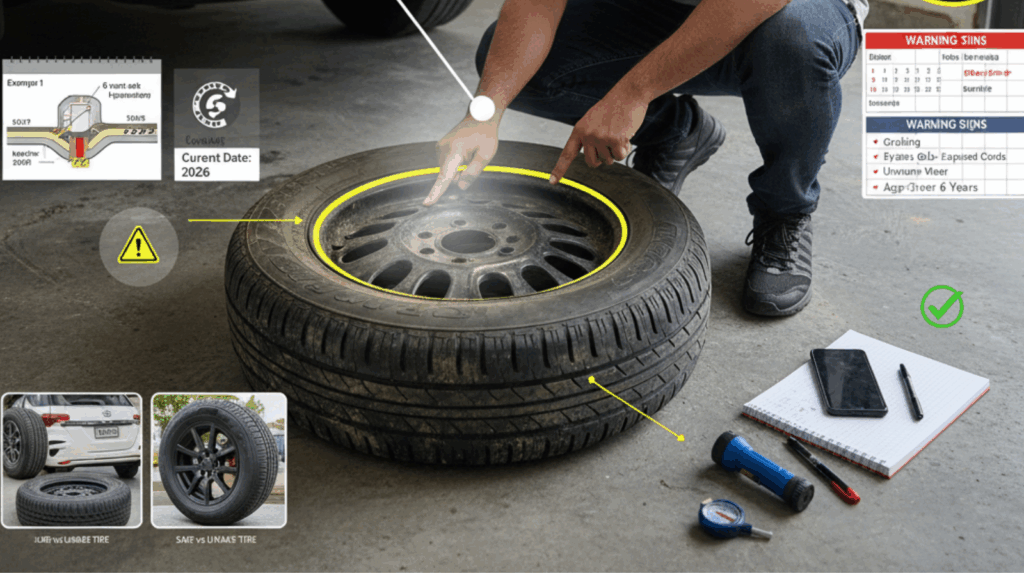
Now let’s get practical about tire expiry. Every tire manufactured has a date code stamped into the sidewall. This tire expiry code tells you exactly when the tire was made, allowing you to calculate its age.
Finding the DOT Number
Look at your tire’s sidewall. You’re looking for a code that starts with “DOT” followed by a series of letters and numbers.
The DOT number (Department of Transportation number) contains various information about the tire, but we’re specifically interested in the last four digits, which indicate the manufacturing date.
Where to look:
- The DOT code is usually on the outer sidewall
- Sometimes it’s on the inner sidewall (the side facing the car)
- Look near the rim edge
- It’s usually molded into the rubber, not printed
What it looks like:
DOT XXXX XXXX 3521
That last four-digit number (3521 in this example) is what you need.
Reading the Date Code
The four-digit date code is simple once you understand the format:
First Two Digits = Week of Manufacture
Last Two Digits = Year of Manufacture
Examples:
3521 means:
- Week 35 (35th week of the year)
- Year 2021
- This tire was manufactured in late August/early September 2021
0119 means:
- Week 01 (first week of the year)
- Year 2019
- This tire was manufactured in early January 2019
5216 means:
- Week 52 (last week of the year)
- Year 2016
- This tire was manufactured in late December 2016
Older Tires (Pre-2000)
Tires manufactured before the year 2000 only have a three-digit code. If you find a three-digit code instead of a four-digit code, that tire is AT LEAST 25+ years old and should be replaced immediately, no questions asked.
Example: 459 means week 45 of 1999 (or possibly 1989 – you can’t tell which decade from a three-digit code).
If your tire has a three-digit code, it doesn’t matter when exactly it was made – it’s dangerously old and needs to be replaced immediately.
How Old Is Too Old? The Age Limits You Need to Know
So now you know how to find your tire’s age. The next question: when is it too old to use safely?
Industry Recommendations
Major Tire Manufacturers (Michelin, Bridgestone, Continental, Goodyear):
- Recommend inspection after 5 years
- Recommend replacement after 10 years maximum
- Some recommend replacement after 6 years regardless of condition
Automotive Safety Organizations:
- NHTSA recommends replacement at 6 years
- The British Rubber Manufacturers Association recommends replacement at a maximum of 10 years
- The Japanese Automobile Tire Manufacturers Association recommends replacement at 10 years
Vehicle Manufacturers:
Many car manufacturers have specific recommendations:
- Mercedes-Benz: Replace after 6 years
- BMW: Replace after 6 years
- Toyota: Inspect after 5 years, replace after 10 years
- Honda: Similar to Toyota
Warning Signs: How to Spot an Aged or Damaged Tire
Beyond checking the date code, you should physically inspect your tires for signs of aging and damage. Here’s what to look for:
Surface Cracking (Dry Rot)
What it looks like: Small cracks in the rubber, usually appearing in a spider-web pattern on the sidewall or between tread blocks.
What it means: The rubber has dried out and is losing its flexibility. The tire’s structural integrity is compromised.
What to do: Replace immediately. Cracked tires can fail without warning.
Common in Pakistan because our heat and UV exposure significantly accelerate this process.
Bulges or Blisters
What it looks like: Raised areas on the sidewall or tread surface that feel soft when pressed.
What it means: The internal structure (usually the steel belts or fabric cords) has separated or failed. The tire is held together only by the outer rubber layer.
What to do: Replace immediately. This tire is at extreme risk of sudden catastrophic failure (blowout).
Common in Pakistan because: Potholes, speed bumps taken too fast, and hitting curbs damage the internal structure.
Discoloration
What it looks like: The tire rubber looks faded, greyish, or has a whitish/chalky appearance rather than deep black.
What it means: The protective oils have evaporated from the rubber surface. The tire is aging, and the rubber is hardening.
What to do: If accompanied by cracks or the tire is 5+ years old, replace it. Severe discoloration, even on newer tires, warrants replacement.
Common in Pakistan because of constant sun exposure, especially for cars parked outside.
Tread Separation
What it looks like: Gaps appearing between tread blocks, areas where the tread seems to be lifting away from the tire body, or actual sections of tread missing.
What it means: The bonding between rubber layers has failed. This is extremely dangerous.
What to do: Replace it immediately and stop driving on this tire.
Common in Pakistan because Heat causes adhesive failure, especially in older or low-quality tires.
What About Tire Storage? Does It Matter?
If you’re storing spare tires or seasonal tires, proper storage significantly affects their lifespan:
Good Storage Practices
Temperature:
- A cool, dry environment is ideal
- Avoid extreme heat (so not in direct sunlight or hot garages)
Position:
- Store tires standing upright if possible
- If stacked, don’t stack more than 4 high
- Rotate the position every few months if stacked
Protection:
- Keep away from direct sunlight
- Cover with tire bags or opaque covers
- Keep away from electric motors (they produce ozone)
- Keep away from petroleum products, solvents, or chemicals
Pressure:
- Maintain proper inflation even during storage
- Check pressure every few months
Bad Storage Practices (Common in Pakistan)
What we see often:
- Spares stored in direct sunlight on rooftops
- Tires stacked outside workshops are exposed to the weather
- Spares stored in extremely hot boots of cars parked in the sun
- Tires stored near generators or electrical equipment
- Spare kept under heavy cargo in the boot
- Tires stored flat with heavy items on top
All of these accelerate aging dramatically. A tire that might last 7 years in good storage might only last 3-4 years in poor storage.
The Cost Reality: Is Replacing Old Tires Worth It?
Let’s talk money, because that’s what stops most people from replacing aged tires.
The Cost of a New Tire
Depending on vehicle and tire type:
- Economy cars (Mehran, Alto, Cultus): Rs. 6,000-10,000 per tire
- Mid-size cars (Civic, Corolla, City): Rs. 10,000-20,000 per tire
- SUVs (Fortuner, Prado): Rs. 15,000-35,000 per tire
- Luxury vehicles: Rs. 25,000-60,000+ per tire
Maintaining Your New Spare Tire
Once you’ve invested in a new spare, maintain it properly:
Monthly Checks
- Check air pressure (use a reliable gauge)
- Visual inspection for obvious damage
- Ensure it’s securely mounted/stored
Every 6 Months
- Remove and thoroughly inspect
- Check date code (track its age)
- Rotate the position if stored loosely to prevent flat spots
- Check the jack and tools
Annually
- Complete condition assessment
- Take it to a professional for inspection if the car is 3+ years old
- Consider swapping into regular rotation if the tire is getting old (so it gets used before expiring)
Use Tire Protection Products
Consider using tire care products to slow aging:
- UV protectant tire dressing
- Tire covers for storage
- Quality tire shine products that include UV protection
FAQs: Tire Expiry
Q: I found my spare tire is 8 years old, but looks perfect – no cracks, good tread, proper pressure. Can I keep using it only for emergencies?
A: No, we strongly recommend replacing it immediately. Here’s why this is so dangerous: what you see on the outside doesn’t reflect what’s happening inside the tire. At 8 years old, especially in Pakistan’s climate, the internal structure has degraded significantly. The rubber has lost flexibility, and the bonds between internal layers have weakened. The tire might hold air and look fine sitting still. Still, under the stress of actual use – especially emergency use, where you might be driving faster or more aggressively to get to safety – it can fail catastrophically without warning. We’ve seen “perfect-looking” 8-year-old tires have complete tread separation within minutes of being put into use. Emergencies are exactly when you need your spare to be 100% reliable, not when you want to discover it’s actually 0% reliable. The risk simply isn’t worth it.
Q: I just bought a “new” spare tire from a local shop but the DOT code showed it was manufactured 4 years ago. Did they cheat me?
A: Tire shops, especially smaller ones, often have inventory that sits for years before being sold. A 4-year-old tire that’s been properly stored (in a cool, dry warehouse away from sunlight and chemicals) is still considered acceptable for sale and use – it’s not “expired” yet. However, you’re absolutely right to be concerned because you’ve essentially lost 4 years of the tire’s usable life before even mounting it. Here’s what you should do: First, inspect the tire carefully for any signs of aging – cracks, discoloration, or hardening. If it shows any of these signs, the storage wasn’t good, and you should return it. Second, consider your vehicle and usage. If this is for a daily driver that you’ll keep for many years, or a vehicle you use for long highway trips, then yes – go back and request a fresher tire (preferably less than 1 year old).
Q: My car is 15 years old and worth maybe Rs. 400,000. The spare tire is original (also 15 years old). Everyone tells me I’m wasting money replacing the spare tire on such an old car. Am I being paranoid, or are they wrong?
A: They’re completely wrong, and this is a dangerous mindset that’s unfortunately common in Pakistan. Let’s think about this logically: The age and value of your car have absolutely nothing to do with whether tire failure can hurt or kill you. A 15-year-old Mehran traveling at 80 km/h has the same kinetic energy as a brand-new Prado traveling at the same speed. The physics of a blowout-induced loss of control are identical. The potential for serious injury or death is identical. Your life and your passengers’ lives aren’t worth less because the car is older. Here’s the other thing people don’t consider: you might have a Rs. 400,000 car, but a tire-failure accident can easily cause Rs. 200,000-500,000 in damage even in a minor incident.
The Bottom Line: Your Safety Isn’t Worth Gambling On
A ten-year-old spare tire with perfect tread is like a life jacket full of holes – it looks fine until you actually need it, and then it fails catastrophically at the worst possible moment.
We’ve seen it happen too many times. We’ve heard the stories. We’ve inspected the damaged vehicles. We’ve talked to the families affected.
Every single time, it’s the same thing: “I had no idea tires expired,” or “I thought it looked fine,e” or “I was going to replace it next month.”
Don’t let that be you.
At Autostore.pk, we’re not trying to sell you tires you don’t need. We’re trying to keep you safe. Check your spare tire expiry date today. If it’s old, replace it. If you’re not sure, bring it to us or any reputable tire shop and have it professionally inspected.
Your family’s safety is worth more than Rs. 10,000.